 +91-95913-21052
 enquiries@prajeeva.com

 Book
Consultation
Book
Consultation


Whole-Body Cryotherapy -
Three Minutes That Reset Your Inflammation, Mood and Recovery
Whole-body cryotherapy exposes the body to extreme cold (approximately -110°C to -130°C) for two to three minutes. The physiological response that follows is remarkable: pro-inflammatory cytokines drop, norepinephrine surges, autonomic balance shifts toward recovery and the body activates the hormetic adaptations that build long-term resilience.

Why Prajeeva Uses An
Electric Cryochamber
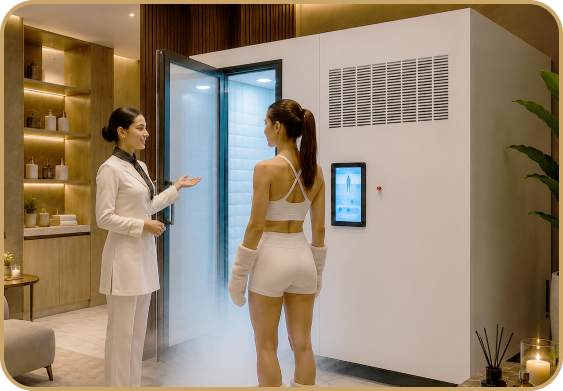
Most whole-body cryotherapy in India — and indeed globally in the spa-wellness segment — is delivered through nitrogen-cooled cryosaunas. The patient steps into an open-top chamber filled with vaporised liquid nitrogen, with their head remaining above the chamber rim. This is the cheaper, more widely-available technology. It is not, however, the technology Prajeeva has chosen.
Prajeeva uses a modern electric cryochamber, which cools ambient air through advanced refrigeration rather than nitrogen vapour. The patient enters a fully enclosed chamber, including the head, in cooled air at temperatures clinically equivalent to nitrogen systems. The clinical advantages are real, not marginal.
Features
Nitrogen Cooled System
Electric Cryochamber (Prajeeva)
Cooling Method
Vaporised liquid nitrogen flooding an open-top chamber.
Refrigerated ambient air in a fully enclosed chamber.
Body Coverage
Head remains above the chamber. Only the body is exposed.
Full-body exposure including head, neck and upper face.
Asphyxiation Risk
Nitrogen displaces oxygen. Documented fatal incidents from ventilation failure.
None. No oxygen displacement is possible.
Temperature Consistency
Variable. Nitrogen vapour layers stratify within the chamber.
Uniform throughout the enclosure.
Operating Temperature
-130°C to -170°C surface temperature.
-110°C to -140°C controlled chamber temperature.
Logistics
Requires nitrogen delivery, storage and refill infrastructure.
Standard electrical supply. No volatile gas infrastructure.
Adoption Pattern
Common in spa-grade installations due to lower capital cost.
Increasingly the standard in serious medical and sports performance settings.
Nitrogen cryotherapy is not unsafe when properly managed. But it is meaningfully less safe than electric cryotherapy, and it does not deliver true whole-body cooling. For a clinical centre, electric is the right choice.
Discuss Cryotherapy Safety and SuitabilityWhat Happens to Your Body in
Three Minutes of Cold
The physiological cascade triggered by whole-body cryotherapy is rapid, well-characterised and
measurable.
Understanding what actually occurs in those three minutes is the difference between
booking a wellness experience and receiving a clinical intervention.
#01
In The First 30 Seconds
Skin temperature drops rapidly from approximately 32°C to below 5°C. Cold receptors fire intensely. The sympathetic nervous system activates. Peripheral blood vessels constrict sharply, shunting blood to the body’s core to preserve organ temperature. Adrenaline and norepinephrine begin to surge.
#02
Through The Next Two Minutes
Norepinephrine levels rise to approximately 200–300% of baseline. The hypothalamus modulates the stress response. Pro-inflammatory cytokines including IL-6 and TNF-α begin to suppress. Endogenous opioid systems activate, contributing to the immediate post-session mood elevation most patients experience. Brown adipose tissue activates, contributing to metabolic stimulation.
#03
During The Following Hours
Vasodilation rebounds, flushing the previously constricted peripheral tissues with oxygenated blood and inflammatory clearance support. Parasympathetic nervous system activity rises — measurable as increased HRV. The reduced inflammatory cytokine signature persists for hours. The mood elevation continues, often described as a sustained sense of clarity and calm energy.
#04
Over Weeks Of Consistent Use
Repeated cryotherapy produces hormetic adaptation — the body becomes biologically more resilient to other stressors. Baseline inflammatory markers reduce. Autonomic balance improves. Sleep quality typically improves through the parasympathetic shift. Norepinephrine sensitivity recalibrates, producing more sustainable mood and energy regulation.
The therapy lasts three minutes. The biology continues for hours. The adaptations accumulate over weeks.
Understand the Physiology in DetailWhat the Evidence Supports
Whole-body cryotherapy has been studied across athletic recovery, inflammatory conditions, mood disorders, sleep and autonomic regulation. The evidence base is uneven across applications — strongest in recovery and inflammation, emerging in mood and cognitive applications, suggestive in longevity. Prajeeva presents this honestly rather than overclaiming.
Application
What Evidence Supports?
Strength
Post-Exercise Recovery
Reduces delayed-onset muscle soreness, accelerates return to baseline performance, reduces exercise-induced inflammation.
Strong
Inflammatory Marker Reduction
Measurable reduction in IL-6, TNF-α and CRP over consistent treatment courses.
Strong
Mood Regulation and Depression
Adjunctive benefit in major depressive disorder demonstrated in controlled trials. Norepinephrine-mediated mood elevation in healthy adults.
Moderate
Sleep Quality
Improved sleep onset and sleep architecture through parasympathetic activation. Most pronounced when timed in the afternoon, not late evening.
Moderate
Autonomic Balance (HRV)
Measurable increase in HRV indicating parasympathetic shift and stress recovery improvement.
Moderate
Chronic Inflammatory Conditions
Adjunctive benefit demonstrated in rheumatoid arthritis, ankylosing spondylitis and fibromyalgia. Used as part of multimodal protocols.
Moderate
Prajeeva applies cryotherapy where the evidence is strongest and uses honest framing where it is emerging. The therapy is most clinically useful for recovery, inflammation, autonomic regulation and mood support — where the evidence is genuinely strong.
Discuss Whether Cryotherapy Suits YouWho Benefits Most From Cryotherapy
Cryotherapy is most clinically useful when matched to a specific physiological pattern. The patients who benefit most from a structured cryotherapy course typically share one or more of the following profiles.
Strong Clinical Fit :
-
Athletes And Performance-Focused Individuals Seeking Recovery Acceleration Between Training Sessions Or After High-Load Events.
-
Patients with chronic systemic inflammation reflected in elevated hs-CRP, IL-6 or other inflammatory markers.
-
Patients with autonomic dysregulation — low HRV, poor stress recovery, sympathetic dominance.
-
Patients With Persistent Mild-To-Moderate Depressive Symptoms, Anxiety Or Low Mood Not Requiring Active Psychiatric Treatment.
-
Patients with disrupted sleep architecture where parasympathetic activation may help re-establish sleep quality.
-
Patients with chronic inflammatory pain conditions — fibromyalgia, rheumatoid arthritis, ankylosing spondylitis — as part of multimodal protocols.
-
Burnout Recovery Patients In The Post-Acute Phase Needing Sustained Autonomic Re-Regulation.
-
Founders, executives and high-performance professionals managing recovery in demanding lifestyles.
Where Cryotherapy Is Not Used :
-
Uncontrolled Hypertension Or Recent Cardiovascular Events — The Acute Sympathetic Surge During Exposure Is A Relative Contraindication.
-
Severe Raynaud’s phenomenon or cold-induced vasculopathy.
-
Pregnancy.
-
Severe Respiratory Disease — Cold Air Exposure May Trigger Bronchospasm.
-
Open wounds, recent surgical sites or compromised skin integrity.
-
Cardiac pacemaker (relative contraindication — manufacturer guidance reviewed individually).
-
Severe Cold Urticaria Or Cold Allergy.
Every patient is clinically assessed before their first cryotherapy session. This is not optional, and it is not waived for repeat patients between courses. The brief medical screen is what distinguishes a clinical cryotherapy service from a spa cryotherapy service.
Book a Cryotherapy Suitability Assessment
What a Session at Prajeeva Looks Like?
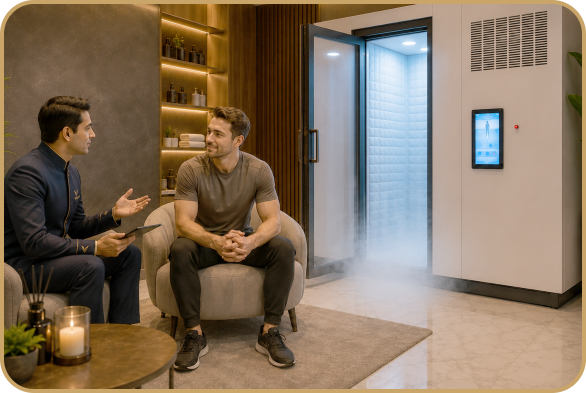
Patients attending Prajeeva for whole-body cryotherapy follow a consistent clinical protocol designed for safety, comfort and outcome. The session itself is brief, but the structure around it matters.


How Cryotherapy Fits Into the Wider Prajeeva Platform
Cryotherapy is most clinically powerful when it is one component of an integrated physician-designed protocol — not a standalone experience booked at random. Several integration patterns are common across Prajeeva’s patient population.
Integration Pathway
Clinical Rationale
Within Burnout Recovery
Cryotherapy supports autonomic re-regulation alongside HRV biofeedback, IV NAD+, sleep optimisation and HPA axis restoration. The norepinephrine response also addresses the mood flatness common in late-stage burnout.
Within Live Longer Protocols
Cryotherapy contributes to chronic inflammation reduction — a core driver of biological ageing. Paired with HBOT, infrared sauna and metabolic correction for an integrated inflammation-reduction strategy.
Within Perform Better / Recovery Protocols
The most direct application. Used for post-training recovery, inflammation modulation and HRV-based recovery tracking. The strongest evidence base sits here.
Adjunctive To Mental Health Support
Used as an adjunct (not replacement) for patients with persistent low mood or anxiety, where the norepinephrine response and parasympathetic activation produce measurable mood benefit.
Standalone Wellness Use
Available for patients who want cryotherapy as a discrete intervention. Still preceded by clinical screening, but no broader programme commitment required.
Every cryotherapy course at Prajeeva is preceded by an HRV baseline and — where clinically relevant — inflammatory marker testing. This allows the clinical team to demonstrate measurable change over the course, rather than relying on subjective impression alone.
Discuss an Integrated Cryotherapy PathwayWhy This Matters -
Choosing Where To Receive
Cryotherapy
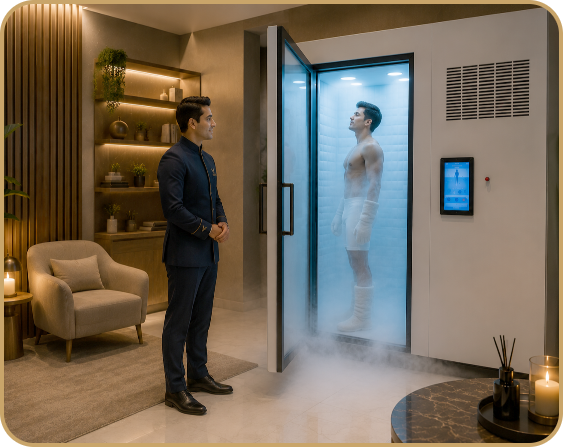
Cryotherapy is widely available in India through wellness spas, fitness studios and beauty centres. The therapy itself is increasingly familiar. What is not always understood is how meaningfully the clinical context changes the outcome — and the safety profile.
Spa-grade cryotherapy is typically delivered without medical screening, without clinical objective-setting, without outcome measurement and frequently using nitrogen-cooled equipment with the safety considerations described above. It is positioned as a wellness experience, and is priced accordingly.
Clinical cryotherapy at Prajeeva is delivered after physician assessment, with defined clinical objectives, measurable biomarkers tracked over the course, electric cryochamber technology and full integration into a broader patient pathway. The cost difference reflects this. So does the outcome.
Cryotherapy in a spa is an experience. Cryotherapy at a physician-led clinical centre is a treatment. The technology may look similar from the outside. The clinical intent is fundamentally different.
For patients seeking the wellness experience, the spa option may be entirely appropriate. For patients with clinical objectives — recovery from a defined injury, management of chronic inflammation, support for an established mood concern, integration into a structured longevity programme — the clinical context produces different outcomes.
Book a Cryotherapy Consultation Speak With Our Clinical Team
