 +91-95913-21052
 enquiries@prajeeva.com

 Book
Consultation
Book
Consultation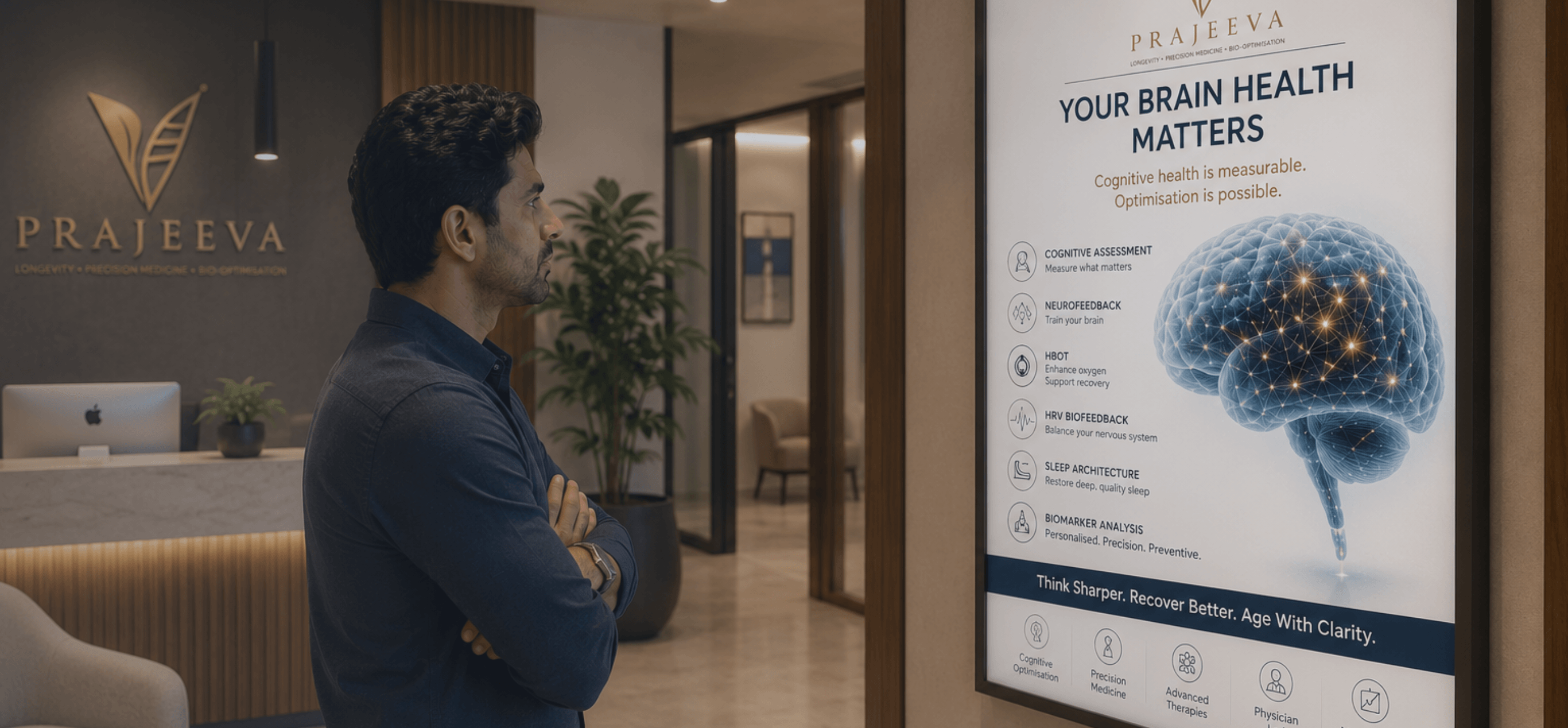


Your Brain Is the Most Important Organ
You Have Never Had Assessed.
Most people have had their cholesterol checked, their blood pressure monitored and their heart listened to. Very few have had their cognitive function objectively measured. At Prajeeva, we treat brain health as a clinical priority — not a lifestyle aspiration.
 Think
Sharper.
Think
Sharper.
 Recover
Better.
Recover
Better.
 Age With
Clarity.
Age With
Clarity.

Cognitive Decline
Rarely Announces Itself
Cognitive change rarely arrives as a dramatic event. It arrives quietly.
It is the afternoon when concentration begins to slip. The meeting where you are physically present but
mentally somewhere else. The decision that used to feel instinctive but now requires more deliberate
effort. The growing impatience you cannot fully explain. The sleep that no longer restores. The sense that
your thinking used to be sharper than it is now.
These are not personality changes. They are physiological signals — the brain communicating, in the only
language it has, that its operating conditions are suboptimal. The brain is closely connected to sleep
architecture, metabolism, inflammation, hormones, nutrition, emotional load and nervous system regulation.
When any of these systems falter, the brain shows it before almost any other organ.
The Think Sharper programme begins by making the invisible visible. Through objective cognitive assessment, sleep architecture analysis, neuroinflammatory biomarkers and autonomic function measurement, Prajeeva identifies what is changing in your cognitive biology while change is still most reversible.

Most people have never had their cognitive function objectively measured. They have intuitions about whether they are sharper or duller than they used to be — but no actual data.
At Prajeeva, every Think Sharper patient receives a comprehensive cognitive assessment using a validated digital cognitive battery, benchmarked against age and education-matched normative data. The assessment takes approximately 60 minutes and evaluates five core domains of cognitive function:
Cognitive Domain
What it Measures?
Processing Speed
How quickly the brain interprets information and generates responses. Among the earliest domains to decline with chronic stress, poor sleep and ageing.
Working Memory
The brain’s capacity to hold and manipulate information in real time — essential for decision-making, planning and complex reasoning.
Sustained Attention
The ability to maintain focus on a single task over time. Often the most affected domain in high-cognitive-demand professionals.
Executive Function
Planning, organisation, cognitive flexibility, impulse control. Frontal lobe function that underpins judgement and complex reasoning.
Reasoning
Pattern recognition, abstract thinking, problem-solving capacity. The cognitive substrate of strategic thinking.
If we do not measure cognitive function objectively, we cannot tell whether an intervention has worked. Subjective impressions of feeling sharper are not the same as measured improvements in processing speed and working memory. Prajeeva works with data, not impressions.
Cognitive function is not produced by the brain in isolation. It is the output of multiple biological systems — metabolic, hormonal, inflammatory, nutritional, vascular — working together. The Prajeeva brain health panel is selected on the basis of established evidence linking each biomarker to cognitive outcomes.
Biomarker
Why It Matters for Brain Health?
hs-CRP & homocysteine
Systemic and neurological inflammation. Chronic neuroinflammation drives cognitive decline, depression and dementia risk decades before symptoms appear.
Omega-3 Index
Red cell EPA+DHA percentage. Omega-3 deficiency is associated with reduced cognitive performance, depression risk and accelerated brain volume loss with age. Most Indian patients run well below the protective 8–12% target.
Vitamin D, B12, folate
Critical for cognitive function, mood regulation and neurotransmitter synthesis. Sub-optimal levels are common in Indian patients and directly correctable.
Full thyroid panel (free T3, free T4, TSH, antibodies)
Subclinical thyroid dysfunction frequently presents with cognitive symptoms — brain fog, slow thinking, memory complaints — long before TSH crosses the conventional reference range threshold.
HbA1c & fasting insulin
Insulin resistance affects the brain directly. ‘Type 3 diabetes’ refers to the metabolic dysfunction in the brain that drives Alzheimer’s pathology. HOMA-IR detects this years before HbA1c rises.
ApoE genotype
ApoE4 allele carriers have substantially elevated lifetime Alzheimer’s risk. Knowing genotype enables aggressive lifestyle and metabolic intervention in carriers — a meaningful prevention opportunity.
Cortisol awakening response
Four-point salivary cortisol profile. Reveals HPA axis dysregulation that drives sleep disruption, cognitive fog and emotional dysregulation.
Hormonal panel (testosterone, DHEA-S, oestradiol)
Sex hormones substantially influence cognitive function, mood and brain ageing. Perimenopausal cognitive change in women is frequently dismissed but highly responsive to identification and management.
Every biomarker is interpreted by a physician within the context of the individual’s clinical picture, cognitive assessment results and lifestyle factors — not against a generic reference range. South Asian-specific reference ranges are applied throughout.
Dementia Is Substantially Preventable. Most Of It Is Visible Years Earlier.
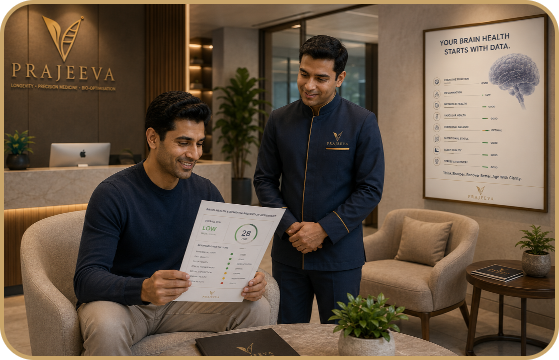
Dementia affects 7 to 8% of Indians over 60 and rises sharply with age. By 2050, Indian dementia cases are projected to exceed 14 million. For families that have watched a parent or grandparent navigate dementia, the fear of cognitive decline is rarely abstract.
Yet the most important finding of modern neuroscience is that this trajectory is substantially preventable. The 2024 Lancet Commission on Dementia Prevention, Intervention and Care identified 14 modifiable risk factors that together account for approximately 45% of all dementia cases worldwide. Each of these factors is detectable years — often decades — before any cognitive symptom appears. Each is addressable through specific interventions.
The 14 Modifiable Risk Factors :
- Lower Educational Attainment
- Physical Inactivity
- Excessive Alcohol Consumption
- Hearing Loss (Untreated)
- Diabetes And Pre-Diabetes
- Social Isolation
- High Ldl Cholesterol
- Smoking
- Air Pollution Exposure
- Depression
- Hypertension
- Visual Impairment (Untreated)
- Traumatic Brain Injury
- Obesity And Visceral Adiposity
At Prajeeva, every Think Sharper patient is assessed against this framework. Each modifiable risk factor is
measured — lipid profile and ApoB for cholesterol, HOMA-IR for diabetes risk, ambulatory blood pressure for
hypertension, body composition for visceral adiposity, cognitive battery for depression-cognitive overlap,
hearing assessment, alcohol intake review. A personalised intervention plan is built around the specific
risk profile, not generic lifestyle advice.
The earlier this work is done, the more reversible the trajectory. The Think Sharper programme is designed
for the 35–60 age window — the period in which intervention has the greatest cumulative effect on long-term
cognitive outcomes.
HBOT - Direct Evidence Of Cognitive Enhancement In Healthy Adults
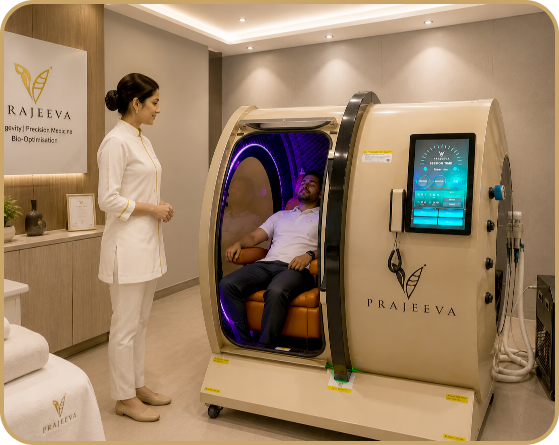
Among the advanced therapies available for cognitive health, Hyperbaric Oxygen Therapy has the strongest published evidence base for measurable cognitive improvement in healthy adults.
In 2020, Dr. Shai Efrati and Amir Hadanny published a landmark study in the journal Aging following 35 healthy adults aged 64 and older through a 60-session HBOT protocol. The cognitive findings were striking: significant improvements in attention, information processing speed and executive function — precisely the cognitive domains most vulnerable to ageing and chronic stress. These were not subjective improvements. They were measured using validated neuropsychological assessment.
HBOT works on the brain through multiple mechanisms. It increases cerebral blood flow through angiogenesis (new blood vessel formation). It reduces neuroinflammation. It supports mitochondrial function in neurons. It activates neuroplasticity pathways that allow the brain to build and strengthen new connections. The net effect is not cognitive enhancement through stimulation — it is cognitive restoration through repair.
The brain does not decline because it forgets how to work. It declines because it stops receiving what it needs to repair. HBOT gives it back the resources to heal itself.
At Prajeeva, HBOT for cognitive applications is integrated into the Think Sharper protocol where clinically indicated, following physician assessment. Every patient is screened for contraindications. Sessions are sequenced alongside other modalities — neurofeedback, HRV biofeedback, transcranial photobiomodulation — according to physician-designed personalised protocols.
Explore HBOT for Brain HealthNeurofeedback - Training The Brain To Function Better
Neurofeedback is one of the most established non-pharmacological brain training methods in clinical neuroscience. It uses real-time EEG measurement to display the patient’s own brainwave activity, allowing the brain to learn through operant conditioning to produce more functional patterns.
The evidence base is strongest for ADHD, anxiety disorders and sleep regulation. Emerging evidence supports applications in executive function enhancement, processing speed, peak cognitive performance and post-concussion recovery. In a Think Sharper context, neurofeedback is applied to address specific patterns identified through cognitive assessment — reduced sustained attention, poor executive control, anxiety-related cognitive interference, sleep dysregulation.
Each neurofeedback session lasts approximately 45 to 60 minutes. The patient sits comfortably while EEG sensors measure brainwave activity. A computer interface provides real-time feedback — typically through visual or auditory cues — that helps the brain progressively learn to produce more functional brainwave patterns. Sessions are typically delivered twice weekly. Patients in the Think Sharper Essentials programme receive 12 sessions; Complete patients receive 24; Annual 365 members receive up to 40 across the year.
At Prajeeva, neurofeedback is delivered using clinical-grade equipment with physician oversight throughout. Cognitive assessment baseline and exit measurements are used to track whether the training is producing measurable cognitive change — not subjective improvement, but objective improvement in the cognitive domains targeted.
Explore Neurofeedback at PrajeevaHRV Biofeedback -
The Autonomic Foundation Of Cognitive
Performance
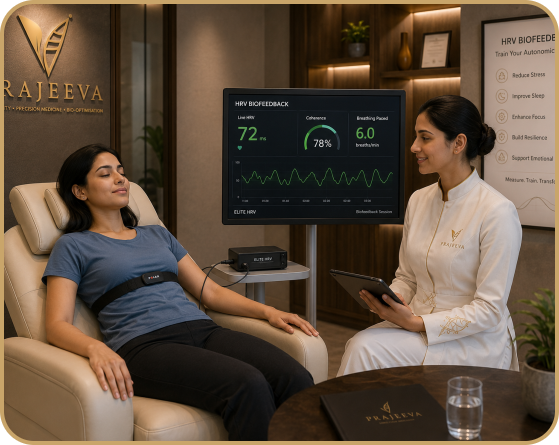
The autonomic nervous system — the system that regulates stress response, recovery, sleep and emotional regulation — is the foundation on which cognitive function rests. When autonomic balance is poor, every cognitive domain suffers. Sleep becomes disrupted. Stress recovery slows. Attention narrows. Emotional regulation falters. Decision quality declines.
Heart Rate Variability (HRV) is the most accessible objective measurement of autonomic function. High HRV reflects strong vagal tone, good parasympathetic activation and effective stress recovery. Low HRV reflects autonomic dysregulation — the physiological signature of chronic stress, poor sleep and burnout.
HRV biofeedback training uses real-time HRV measurement to train the autonomic nervous system, primarily through resonance breathing. By breathing at a specific paced rate (typically around 6 breaths per minute), patients can measurably increase vagal tone and HRV amplitude over weeks of practice. The evidence base is substantial — strong findings across anxiety, stress resilience, insomnia, executive function and emotional regulation.
At Prajeeva, HRV biofeedback uses clinical-grade ECG monitoring via the Polar H10 sensor paired with the Elite HRV training platform. Patients learn resonance breathing in supervised sessions and continue practice at home, with home practice data syncing to the clinical record for physician review. Essentials patients receive 8 in-clinic sessions; Complete patients receive 16; Annual 365 members receive up to 48 sessions across the year.
Explore HRV BiofeedbackSleep Architecture -
Not A Lifestyle Suggestion. A Tier-1
Cognitive
Intervention.
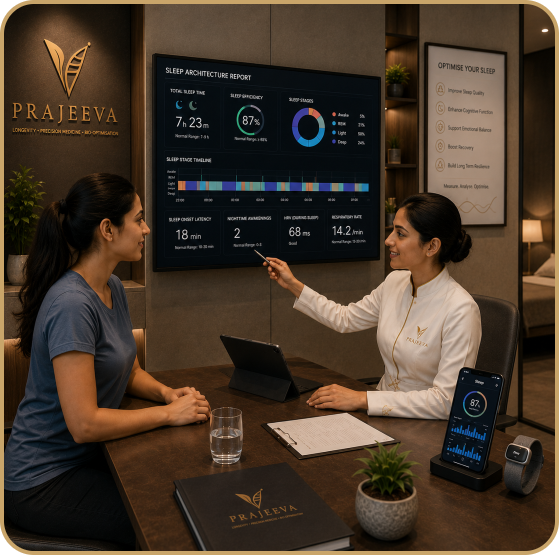
Sleep is the single most important biological process for brain health. During deep sleep, the brain’s glymphatic system clears metabolic waste — including the amyloid and tau proteins implicated in Alzheimer’s disease. During REM sleep, the brain consolidates memory and integrates emotional experience. Disrupted sleep architecture impairs both processes. A 2023 Lancet meta-analysis associated poor sleep quality with approximately 12% higher all-cause mortality.
Most people sleep poorly without realising it. They get into bed at a reasonable hour, sleep for seven hours, and wake unrefreshed. The duration looked right. The architecture did not. Without measurement, the patient cannot know what is actually happening during the night.
At Prajeeva, sleep architecture is assessed through wearable technology integrated into the Think Sharper programme — capturing total sleep time, sleep onset latency, time in each sleep stage (light, deep, REM), nighttime awakenings, HRV during sleep and respiratory patterns. Patients with suspected obstructive sleep apnoea are referred for formal polysomnography. Sleep architecture data is reviewed at every consultation, with specific interventions targeted at the dysfunction identified. Where indicated, interventions may include sleep hygiene refinement, light exposure management, temperature regulation, magnesium and other supplementation, CGM-guided evening nutrition, cognitive behavioural therapy for insomnia (CBT-I), HRV biofeedback for sleep regulation and — in selected patients — pharmacological support.
Understand Your Sleep Architecture
Transcranial Photobiomodulation -
Emerging Technology, Promising
Evidence
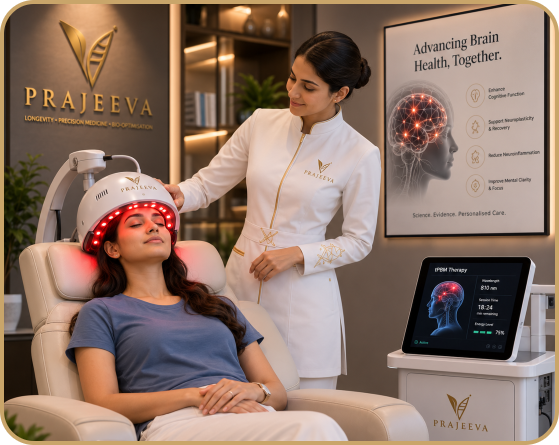
Transcranial photobiomodulation (tPBM) delivers near-infrared light (typically 810–1064nm) to specific regions of the head, where it penetrates the skull and enhances mitochondrial ATP production in cortical neurons via cytochrome c oxidase activation. The mechanism is well-established at the cellular level.
Emerging clinical evidence supports applications in cognitive enhancement, depression, traumatic brain injury recovery, neuroinflammation reduction and — with growing interest — early Alzheimer’s and Parkinson’s disease. The evidence base is earlier-stage than HBOT or neurofeedback, but the mechanism is sound and the safety profile is excellent.
At Prajeeva, transcranial photobiomodulation is integrated into Think Sharper protocols where clinically appropriate, typically as an adjunct to other interventions rather than a standalone therapy. Sessions are brief (15–20 minutes) and well-tolerated. Patients receive a personalised treatment frequency based on the specific clinical indication and integration with other modalities.
Explore Advanced Brain Health Technologies


Built For People
Whose Lives Depend On Their Minds
The Think Sharper programme is designed for individuals whose work, relationships and quality of life depend on sustained cognitive performance — and who recognise that maintaining that performance is a clinical question, not a productivity hack.
This Maybe You If …
-
#01
You Are A Founder, Ceo Or Senior Executive Who Needs Sustained Clarity Under Pressure And Suspects Your Cognitive Bandwidth Is Not What It Was.
-
#02
You Sleep Seven Or Eight Hours And Still Wake Mentally Foggy, And You Want To Know Why — Measured And Explained.
-
#03
You Carry A Family History Of Dementia Or Alzheimer’s And Want To Take Action In The Window When Prevention Is Most Effective.
-
#04
You Are Navigating Perimenopause And Noticing Cognitive Symptoms That Your Gp Has Dismissed As Stress Or Ageing.
-
#05
You Are A High-Performing Professional Who Has Noticed Slower Processing Speed, Reduced Patience Or More Effortful Concentration Over The Past Two To Three Years.
-
#06
You Have Read Peter Attia, Andrew Huberman Or Lisa Mosconi And Want Clinical Access To The Cognitive Longevity Approach They Describe — Led By A Credentialled Neuropsychiatrist, Not A Wellness Practitioner.
-
#07
You Have Recovered From Covid-19 With Residual Cognitive Symptoms And Want A Proper Clinical Workup Rather Than Reassurance.
-
#08
You Are An Athlete Or Former Athlete With A History Of Concussion Who Wants Ongoing Brain Health Assessment.

