 +91-95913-21052
 enquiries@prajeeva.com

 Book
Consultation
Book
Consultation


Living Longer Is Not About Adding Years.
It Is About Protecting Them.
Longevity medicine is not the pursuit of more birthdays. It is the science of preserving the years in
which the body recovers well, the mind stays sharp, metabolism remains stable, and life can still be
lived with energy, independence and purpose.
This is the science of healthspan — and it is what Prajeeva does.
 Live
Longer.
Live
Longer.
 Think
Sharper.
Think
Sharper.
 Perform
Better.
Perform
Better.

The Real Question Is Not
How Long You Live. It Is How Well.
Indian life expectancy has risen by over twenty years in three generations. But healthspan — the years a person spends in good health, with cognitive clarity, physical capacity and independence — has not risen proportionately. The result is increasingly visible: more years lived, but often with the last 10 to 15 of them spent managing chronic disease, declining function and avoidable disability.
Longevity medicine exists to change this trajectory.
It does not ask whether you are sick. It asks how your biology is ageing
right now — and what can still be improved while change is most possible. The 7 to 15 year window between
the first measurable signs of biological dysfunction and a formal clinical diagnosis is the most important
opportunity in modern healthcare. It is also the window most healthcare systems entirely miss.
At Prajeeva, longevity medicine is approached as healthspan medicine. The aim is not to add years for their own sake. The aim is to protect the years in which the body is genuinely capable, the mind is genuinely clear and life is genuinely worth living.
Your Biological Age Tells A Story
Your Birthday Cannot

Chronological age counts the number of birthdays you have completed. Biological age measures how your body is actually functioning at the cellular and molecular level. These two numbers are rarely identical.
Two people may both be 45. One has the metabolic profile of a 35-year-old — strong recovery, restorative sleep, preserved muscle mass, stable energy, low inflammation, sharp cognition. The other has the biological profile of a 55-year-old — persistent fatigue, slow recovery, rising visceral fat, declining strength, accumulating inflammation, cognitive softness. The chronological number is the same. The biological reality is a full decade apart. In the Indian population, this divergence is particularly stark: South Asian physiology accumulates visceral adiposity and insulin resistance at lower BMI thresholds than Western populations, meaning biological age can be running well ahead of chronological age even in individuals who appear lean and healthy by conventional measures.
Biological age is also modifiable. This is one of the most important findings of modern ageing science. The cellular processes that drive ageing — mitochondrial decline, chronic inflammation, hormonal change, oxidative stress, accumulating senescent cells — are measurable today and responsive to targeted intervention.
How We Measure Biological Age At Prajeeva :
-

PhenoAge
A validated biological age assessment developed by Dr. Morgan Levine (Yale), using nine key blood biomarkers including hs-CRP, glucose and albumin. It predicts long-term health risk more accurately than chronological age alone.
-

TruAge (TruDiagnostic)
An advanced DNA methylation test that measures biological ageing using validated epigenetic clocks, including DunedinPACE, which tracks the real-time pace of ageing. Available as a premium assessment.
-

GlycanAge
Measures biological age through Immunoglobulin G (IgG) glycosylation patterns, providing insight into inflammatory ageing. Particularly valuable for assessing age-related inflammatory changes, including during perimenopause.
These measurements are not curiosities. Each operates on a different biological substrate — blood chemistry, epigenetic methylation, immunoglobulin glycosylation — and each delivers a distinct, actionable insight. Together they provide a multi-dimensional picture of cardiovascular risk, inflammatory burden, metabolic resilience, neurological ageing trajectory, and the rate at which biological ageing is currently occurring. This is the foundation on which every Prajeeva intervention plan is built.
The cells that make up your body do not check the calendar. They respond to how they are fed, used, rested, repaired and stressed. Biological age is the closest measurement we have of how well you are doing all of those things.
Explore Biological Age Testing
Standard health checks measure a narrow range of markers designed to detect disease once it has crossed a diagnostic threshold. Longevity medicine measures different things — markers that reveal how the underlying systems of ageing are performing decades before disease arrives.
The Prajeeva longevity panel is selected on the basis of established evidence linking each biomarker to lifespan or healthspan outcomes. Every marker is interpreted by a physician within the context of the individual’s clinical picture, not against a generic reference range.
Biomarker
Why It Matters for Longevity?
ApoB & Lipoprotein(a)
The most accurate predictors of cardiovascular risk available. ApoB measures the total number of atherogenic lipoprotein particles, regardless of cholesterol content. Lp(a) reveals genetically determined cardiovascular risk that standard lipid panels miss entirely.
HOMA-IR & Fasting Insulin
Detect insulin resistance years before fasting glucose or HbA1c rises. Type 2 diabetes develops over 10–15 years; HOMA-IR identifies the highest-leverage intervention window.
hs-CRP & Homocysteine
hs-CRP is a marker of low-grade systemic inflammation associated with cardiovascular and metabolic disease. Homocysteine reflects methylation status and is associated with vascular and neurological health. Together they help identify hidden inflammatory and metabolic risk.
Omega-3 Index
Red cell EPA+DHA percentage. One of the strongest predictors of cardiovascular mortality. Most Indian patients have indices well below the protective 8–12% target.
VO2 Max
The single strongest predictor of all-cause mortality in adults. Each MET increase is associated with 10–25% mortality reduction (Mandsager et al, JAMA Network Open 2018).
Grip strength & body composition
Muscle mass and strength are independent predictors of mortality and disability-free years. Sarcopenia accelerates from age 40 and is largely preventable.
Full hormonal panel
Testosterone, DHEA-S, free T3, cortisol curve. Hormonal decline drives recovery capacity, body composition, cognitive function and metabolic health from middle age onwards.
Vitamin D, B12, ferritin
Nutrient sufficiency markers with disproportionate impact on cognition, energy and immune function. Frequently overlooked despite being directly correctable.
Metabolic Health Is The Foundation Of Healthy Ageing
fasting glucose, insulin resistance, central adiposity, dyslipidaemia or hypertension. Most of these abnormalities develop silently for a decade or more before any conventional diagnosis is made.
Type 2 diabetes is the clearest example. It does not appear suddenly. It progresses through measurable stages of insulin resistance over 10 to 15 years. By the time HbA1c crosses the diagnostic threshold of 6.5%, vascular damage has typically begun, the metabolic machinery has been under strain for years, and the diagnostic window for the highest-leverage intervention has already closed.
Longevity medicine identifies this trajectory at its earliest measurable stage. Fasting insulin and HOMA-IR detect insulin resistance years before glucose tolerance declines. Continuous glucose monitoring reveals glycaemic variability invisible to a single fasting reading. ApoB and Lipoprotein(a) reveal cardiovascular risk that standard lipid panels miss. Visceral adiposity measured by bioelectrical impedance body composition analysis reveals metabolic risk that BMI alone cannot capture. This is particularly important in the Indian population. South Asian physiology accumulates pathological visceral fat at a BMI of 23 — a threshold at which most Western protocols would not flag any concern. Waist circumference above 90cm in Indian men and 80cm in Indian women carries cardiovascular risk equivalent to obesity by Western BMI criteria. Prajeeva applies Indian-specific reference ranges throughout — not generic Western norms imported unchanged.
Once detected, metabolic decline is among the most reversible drivers of biological ageing. Targeted nutrition, structured exercise prescription, sleep optimisation, stress regulation and — where indicated — pharmacological support can restore metabolic flexibility and meaningfully lower long-term disease risk.
Explore Metabolic Health & Lifestyle MedicineMuscle, Strength And
Vo2 Max - The Most Underrated Longevity
Drivers

In every robust longevity dataset, two physical markers emerge as exceptionally strong predictors of healthy lifespan: cardiorespiratory fitness measured by VO2 Max, and skeletal muscle mass and strength. Their predictive power frequently exceeds that of cholesterol levels, blood pressure or any single biomarker.
Research in 2018 (Mandsager analysis) drawing on data from over 122,000 patients, found that low cardiorespiratory fitness carried a higher mortality risk than smoking, diabetes or end-stage renal disease. Each MET [Metabolic Equivalent of Task which is the amount of energy you expend (and the oxygen your body consumes) while sitting quietly at rest] increase in fitness was associated with 10 to 25% mortality reduction.
Muscle is similarly underrated. After age 40, adults lose 1 to 2% of muscle mass per year if untrained — a process called sarcopenia. Loss of muscle is loss of metabolic capacity, glucose regulation, balance, recovery, independence and ultimately survival. The Prospective Urban Rural Epidemiology (PURE) study of 142,000 adults across 17 countries found that low grip strength predicted all-cause mortality, cardiovascular disease and cancer mortality more strongly than systolic blood pressure.
Yet these are precisely the markers most healthcare systems do not measure. Few adults have ever had their VO2 Max formally assessed. Even fewer track muscle mass and visceral fat through body composition scans over time. Without these measurements, the most important longevity levers remain invisible to the patient.
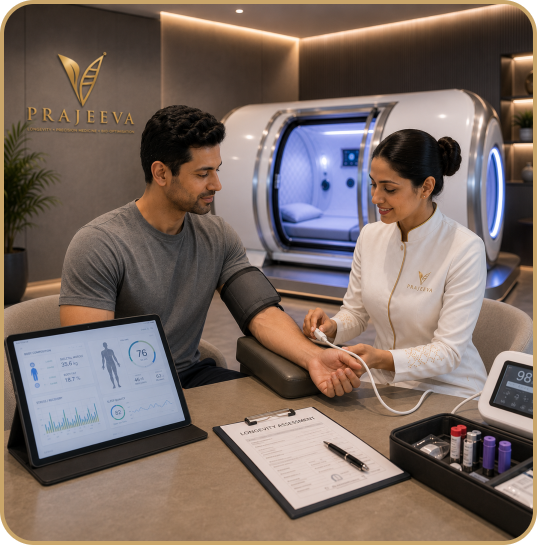
Prajeeva’s assessment programme makes them visible — and provides physician-prescribed protocols to address them. VO2 Max is formally assessed at baseline in every Prajeeva longevity programme using a clinical metabolic analyser, not estimated from questionnaires or wearable algorithms. Skeletal muscle mass, visceral fat area, and body composition are tracked serially using bioelectrical impedance analysis at every visit — because a single measurement is a snapshot, and what matters clinically is the trajectory over time. The Perform Better pillar specifically addresses cardiorespiratory fitness, strength preservation, recovery capacity and the body composition changes that determine long-term physical function.
Explore the Perform Better ProgrammeHBOT - The First Clinical Therapy
To Reverse A Marker Of
Cellular Ageing
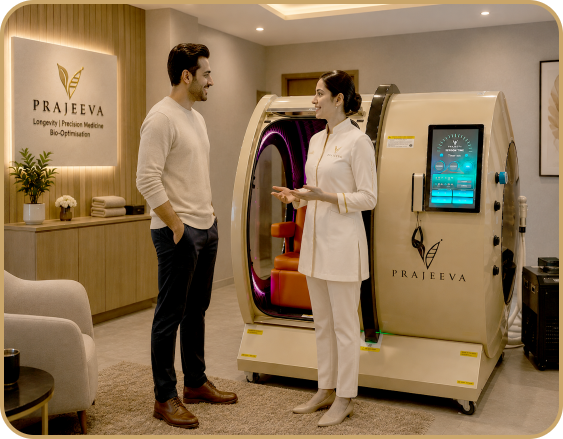
Among the advanced therapies in modern longevity medicine, Hyperbaric Oxygen Therapy has the strongest
published evidence base for direct biological ageing reversal.
In 2020, Dr. Shai Efrati and Amir Hadanny
published a landmark study in the journal Aging following 35 healthy adults aged 64 and older through a
60-session HBOT protocol. The findings reframed what was clinically possible: telomere length — the
protective caps on chromosomes that shorten with age — increased by 20 to 38% in the participants’ blood
cells. Senescent (aged, non-functional) cell populations decreased by up to 37%. Cognitive function in
attention, processing speed and executive function showed measurable improvement.
This was the first human evidence that a non-pharmacological intervention could measurably reverse cellular ageing markers in healthy adults. The implications for clinical longevity medicine were substantial.
HBOT works through a phenomenon known as the hyperoxic-hypoxic paradox. Repeated cycles of high oxygen exposure followed by normal breathing trigger the body’s low-oxygen response pathways — stimulating stem cell release, new blood vessel formation, mitochondrial biogenesis and HIF-1α signalling. The body responds to oxygen abundance the way it responds to oxygen shortage: by building more capacity.
At Prajeeva, HBOT is integrated into longevity protocols where clinically indicated, following physician assessment. Every patient is screened for contraindications. Sessions are sequenced alongside other modalities — IV NAD+ for cellular energy restoration, state-of-the-art electric whole-body cryotherapy for inflammation modulation and autonomic regulation, infrared sauna for vascular conditioning, red light therapy for mitochondrial amplification — according to physician-designed personalised protocols. Our cryotherapy uses a modern electric cryochamber rather than nitrogen-cooled equipment, eliminating nitrogen displacement risks and enabling full-body cooling at consistent therapeutic temperatures.
HBOT is not a wellness procedure. It is a clinical intervention with one of the strongest evidence bases for biological age reversal currently available. Its place in any longevity protocol is determined by clinical assessment, not by patient request.
Explore Hyperbaric Oxygen TherapyCognitive Longevity Is Inseparable From Physical Longevity
For many people, the most feared aspect of ageing is not physical decline but cognitive decline. Dementia affects 7 to 8% of Indians over 60 and rises sharply with age. By 2050, Indian dementia cases are projected to exceed 14 million.
The good news is that dementia is now understood to be substantially preventable. The 2024 Lancet Commission on Dementia Prevention, Intervention and Care identified 14 modifiable risk factors that together account for approximately 45% of all dementia cases worldwide. These factors are addressable. Most are detectable years or decades before any cognitive symptom appears.
Among the most important: midlife hypertension, high LDL cholesterol, hearing loss, physical inactivity, social isolation, depression, diabetes, smoking, obesity and excessive alcohol. Each of these is measurable at Prajeeva. Each is addressable through specific interventions integrated into the longevity programme.
Beyond dementia prevention, cognitive longevity also encompasses the gradual decline in processing speed, working memory and executive function that affects most adults from middle age onwards. These changes — often dismissed as inevitable — are responsive to neurofeedback training, HBOT, transcranial photobiomodulation, sleep architecture optimisation and metabolic correction. At Prajeeva, cognitive baseline is established using a validated digital cognitive battery at programme entry. This gives a quantified, objective measure across processing speed, executive function, working memory and attention — the same domains that decline earliest and most silently. Reassessment at programme exit makes the response to intervention measurable, not anecdotal. Sleep architecture is assessed and monitored throughout using wearable technology integrated into the programme. Sleep is not a lifestyle suggestion at Prajeeva. It is a tier-1 longevity intervention: the 2023 Lancet meta-analysis associates poor sleep quality with 12% higher all-cause mortality. The Think Sharper pillar specifically addresses these dimensions of cognitive longevity through objective measurement and personalised intervention.


The Goal Is Not Extreme Optimisation. It Is Practical Longevity.

Longevity medicine in its most visible form — social media protocols, biohacking culture, the pursuit of every emerging supplement — has earned a reputation for excess. Prajeeva takes a different view.
Doing more is not the same as doing better. Running 200 biomarkers when 30 will answer the clinical question is noise, not signal. Taking 40 supplements when targeted correction of 4 nutrient deficiencies would deliver the same benefit is theatre, not medicine. Cycling through every trending therapy is not the practice of evidence-based clinical care.
The Prajeeva Philosophy Is Straightforward :
- Measure What Matters.
- Understand What Is Changing.
- Intervene Where Evidence Supports It.
- Track Whether The Intervention Is Working.
- Adjust When The Data Says To Adjust.
- Preserve What Must Not Be Lost.
This is how longevity medicine becomes responsible, practical and human. It is not the pursuit of youth. It is the protection of the capacity to live with strength, clarity, energy and purpose for as many years as the body allows. At Prajeeva, every intervention has a measurable target — a biomarker, a biological age score, a DunedinPACE value, a VO2 Max, a cognitive battery result — and every programme ends with evidence of what changed and what did not. That accountability is what separates clinical longevity medicine from everything else currently being sold under that name.
Speak With Our Medical Team Begin Your Longevity Journey
