 +91-95913-21052
 enquiries@prajeeva.com

 Book
Consultation
Book
Consultation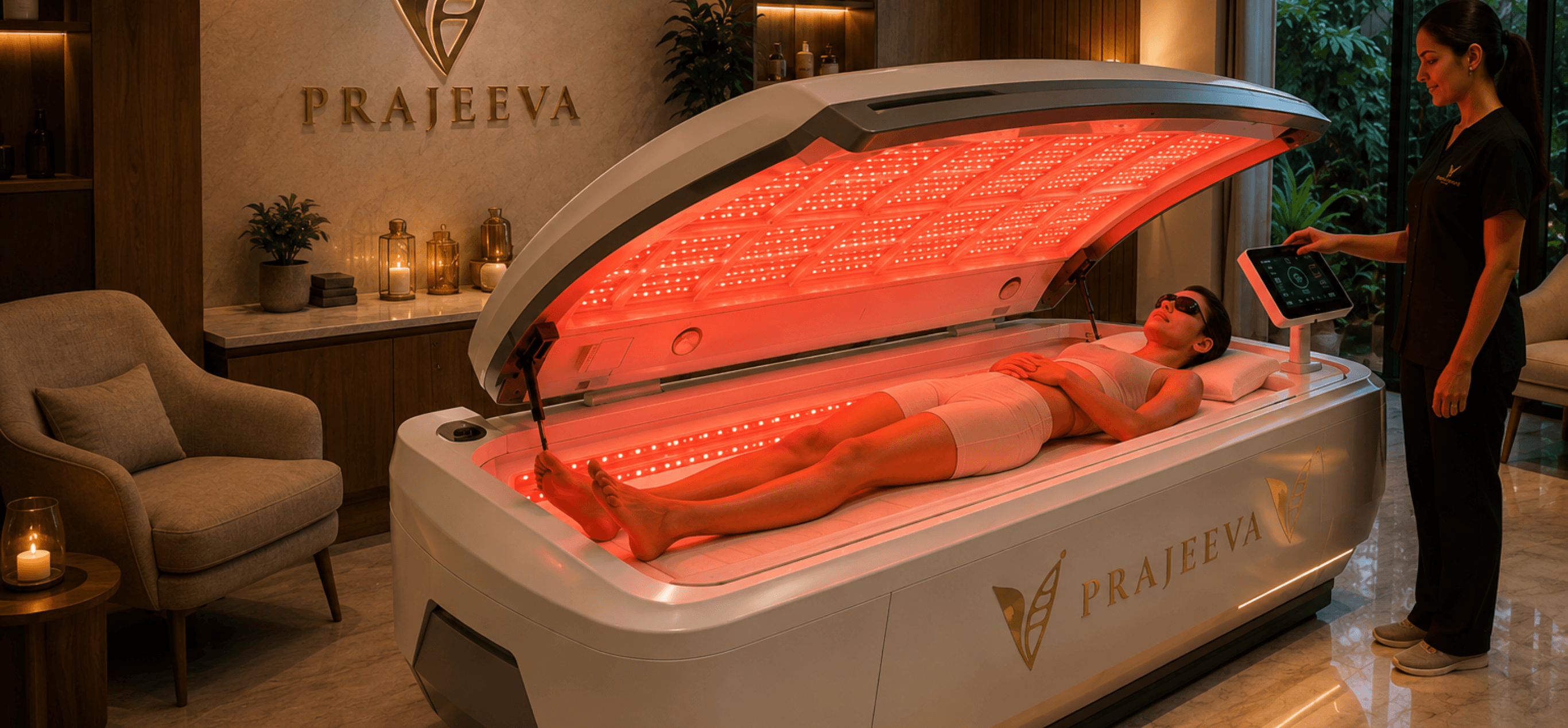


Photobiomodulation Therapy -
Light That Heals From Within
Your cells were built to respond to light. Modern life forgot to remind them. Photobiomodulation is not a wellness trend. It is a precision clinical tool — backed by over three decades of peer-reviewed research — that speaks directly to your mitochondria, your tissue repair systems and your brain’s oldest energy language. Prajeeva delivers photobiomodulation through a clinical-grade, full-body red light therapy bed at carefully selected wavelengths, with transcranial protocols available within the same session for patients with cognitive optimisation indications.

Your Mitochondria
Have Been Waiting For This
Most people picture energy as something they get from sleep or coffee. The truth runs deeper. Every cell in your body makes its own energy — inside tiny structures called mitochondria. Think of them as the body’s internal power stations. When they work well, you feel it: sharp focus, quick recovery, steady stamina. When they slow down, you feel that too — as the kind of fatigue no amount of rest seems to fix.
Photobiomodulation — the clinical name for red and near-infrared light therapy — works by delivering specific wavelengths of light (typically between 630 and 850 nanometres) directly to these power stations. The light is absorbed by a molecule inside the mitochondria called cytochrome c oxidase. This triggers a cascade: ATP production rises, oxidative stress falls, and the cell’s natural repair processes switch on.
This is not a new hypothesis. It is a mechanism confirmed across thousands of peer-reviewed studies — from NASA’s early research on wound healing in the 1990s, to a 2024 consensus review co-authored by more than twenty clinical specialists, to a 2024 FDA authorisation for a light-based treatment for age-related macular degeneration. The science is not catching up with the trend. The trend is catching up with decades of science.
There is actual real science. It is not science fiction. — Stanford Medicine, on photobiomodulation.
Understand the Mechanism in DetailWhy Prajeeva Uses A
Clinical-Grade Full-Body
Bed
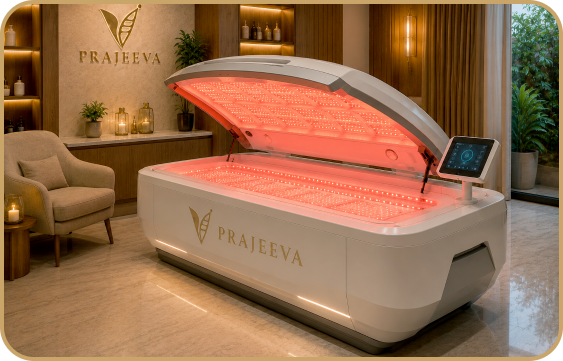
Photobiomodulation is increasingly visible in wellness contexts. Hand-held devices, small panels, helmet units and beauty-grade products are widely available. The technology is spreading faster than the knowledge of how to use it well. What separates a wellness experience from a clinical intervention is the equipment itself, the wavelengths delivered, and the dose received.
Prajeeva operates a clinical-grade, full-body red light therapy bed. The clinical and dose-related advantages are real, not marginal.
Features
Wellness Grade Devices
Prajeeva Clinical Bed
Body Coverage
Hand-held or partial-body panels. Patient repositions during session.
Full-body bed. Even, simultaneous exposure of the entire body surface in a single session.
Wavelength Range
Often single wavelength or narrow band. Variable specification.
660 nm red light (skin and superficial tissue) and 850 nm near-infrared (deeper tissue and brain penetration) delivered simultaneously.
Dose Delivery
Variable, often sub-therapeutic. Dose depends on user positioning.
Calibrated irradiance levels matched to the published therapeutic dose range.
Session Duration
Often 5–10 minutes of partial exposure across multiple sessions.
Single 20-minute full-body session at clinical irradiance.
Transcranial Capability
Generally not present.
Head-focused transcranial protocol available within the standard session for cognitive optimisation patients.
Clinical Oversight
Self-administered, no screening.
Physician-screened (including photosensitising medication review) before first use.
Photobiomodulation is highly dose-dependent. The same wavelength at sub-therapeutic dose produces no measurable effect; at over-dose, it can be counterproductive. Clinical-grade equipment delivers the right dose. Wellness-grade equipment usually does not.
Discuss Whether Photobiomodulation Suits YouWhat the Evidence Supports
Photobiomodulation has been studied across recovery, inflammation, skin health, neurological function and pain. The evidence base is uneven across applications — strongest in tissue repair and inflammation, emerging in cognitive function and longevity. Prajeeva presents this honestly rather than overclaiming.
Application
What Evidence Supports?
Strength
Tissue Healing And Wound Repair
Accelerated wound closure, increased fibroblast activity, collagen synthesis. NASA research foundation; 2024 consensus review.
Strong
Inflammatory Marker Reduction
Measurable reductions in CRP, IL-6 and TNF-α with consistent treatment.
Strong
Muscle Recovery and DOMS
Reduced delayed-onset muscle soreness in multiple controlled trials. Faster return to baseline post-exercise.
Strong
Skin Health (Collagen, Wrinkle Depth)
Red light at 630–670 nm activates fibroblasts and stimulates collagen type I and III synthesis. Measurable improvements in skin firmness over 12 weeks of twice-weekly sessions.
Strong
Pattern Hair Loss
2024 consensus review confirms safety and efficacy in androgenetic alopecia.
Strong
Peripheral Neuropathy
Symptom reduction in diabetic peripheral neuropathy and other peripheral nerve conditions.
Moderate
Prajeeva applies photobiomodulation where the evidence is strongest and uses honest framing where it is emerging. The therapy is most clinically useful for tissue repair, inflammation reduction, recovery and skin health — where the evidence is genuinely strong.
Explore Recovery & Regenerative TherapiesRecovery Is Not Rest.
It Is Repair.
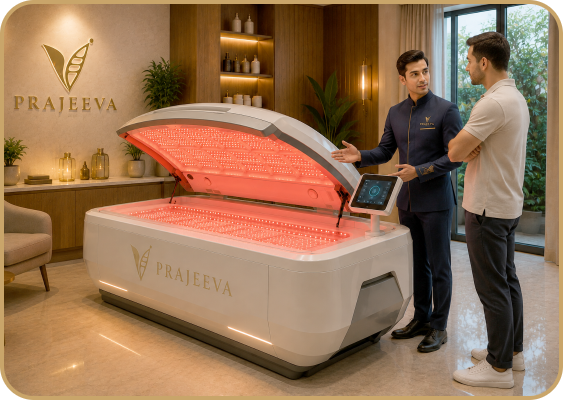
Many high-performing people judge recovery by whether they feel ready again. The more useful question is whether the body has actually repaired. These are not the same thing. You can feel functional and still be carrying accumulated inflammation, elevated cortisol, suppressed immune function and insufficient mitochondrial output — all quietly shaping how you age.
Photobiomodulation intervenes at the biology of repair. PBM reduces circulating inflammatory markers like CRP and IL-6, accelerates tissue healing, and produces measurable reductions in delayed-onset muscle soreness across multiple controlled trials. For athletes and physically demanding professionals, this translates into faster return to baseline performance between sessions and reduced cumulative training stress.
For patients with chronic inflammatory load — elevated hs-CRP, persistent inflammatory pain, autoimmune conditions in stable phase — PBM offers a measurable adjunctive intervention. Used consistently across structured courses, it can produce reductions in inflammatory markers comparable to other anti-inflammatory interventions, without pharmacological burden.
Discuss a Structured PBM CourseYour Brain Feels Your Body’s Light
Before You Do
Most recovery conversations focus on the body. The brain is rarely part of the picture — until cognitive symptoms appear and the conversation shifts to neurologists. Prajeeva’s philosophy treats the brain as inseparable from the body, because the science does too.
Near-infrared light at wavelengths around 810 nanometres penetrates several centimetres into tissue — functional studies suggest meaningful delivery to the outer cortical layers, including the prefrontal cortex. Early research in transcranial photobiomodulation has shown effects on ATP production in cortical neurons, reduced neuroinflammation markers, and improvements in attention, mood and short-term memory — particularly in older adults with mild cognitive decline. The evidence is emerging rather than settled, and Prajeeva uses transcranial PBM as part of an integrated cognitive optimisation pathway rather than as a standalone claim of cognitive enhancement.
At Prajeeva, transcranial photobiomodulation is delivered as part of the standard red light therapy session, with a head-focused protocol positioning the patient to maximise cranial exposure during a portion of the session. Patients in the Prajeeva Think Sharper clinical pathway can incorporate transcranial PBM into their broader cognitive protocol where clinically indicated.
“When the brain is under sustained cognitive and emotional load, it is the first to signal dysfunction — through poor focus, slow decision-making, emotional reactivity and disrupted sleep. Prajeeva’s light protocols address these signals at their biological root, not their behavioural surface.”
Explore Cognitive Optimisation & Brain HealthVisible Change Is Often
A Sign Of Deeper Change
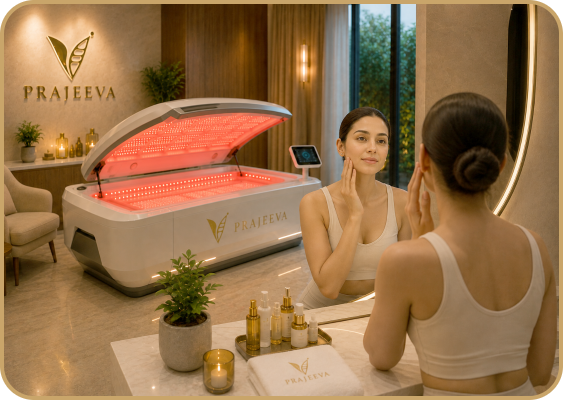
One of the earliest and most visible effects of photobiomodulation is on the skin — and it is
instructive precisely because it shows you a mechanism at work. Red light at 630 to 670 nanometres
activates fibroblasts and stimulates collagen type I and III synthesis. Clinical trials document
measurable improvements in wrinkle depth, skin firmness and dermal density after twelve weeks of
twice-weekly sessions.
But the deeper story is anti-inflammatory. Systemic inflammation is the common
thread beneath most chronic conditions — cardiovascular disease, insulin resistance, autoimmune
dysfunction, hormonal disruption and accelerated cellular ageing. Photobiomodulation reduces
pro-inflammatory cytokines systemically, which is why its effects extend far beyond the skin even when
skin change is what patients first notice.
This dual pathway — visible skin response signalling deeper inflammatory and mitochondrial change — makes PBM a useful entry point into more comprehensive longevity care for patients who arrive interested in aesthetic improvement and discover that the underlying clinical mechanism is broader than they expected.
Explore Metabolic Health & Longevity MedicineWho Benefits Most From Photobiomodulation
Photobiomodulation is most clinically useful when matched to a specific physiological pattern. The patients who benefit most from a structured PBM course typically share one or more of the following profiles.
Strong Clinical Fit :
-
Athletes And Performance-Focused Individuals Seeking Recovery Acceleration Between Training Sessions Or After High-Load Events.
-
Patients with chronic systemic inflammation reflected in elevated hs-CRP, IL-6 or other inflammatory markers.
-
Patients with chronic musculoskeletal pain or post-surgical recovery, where tissue repair benefit is well-documented.
-
Patients Seeking Skin Health Improvement — Collagen Support, Wrinkle Depth Reduction, Dermal Density Restoration.
-
Patients with androgenetic alopecia (pattern hair loss), where the 2024 consensus review confirms efficacy.
-
Patients with diabetic peripheral neuropathy or other peripheral nerve conditions.
-
Patients Within The Think Sharper Cognitive Pathway Who May Benefit From Transcranial Pbm Integration.
-
Patients in Prajeeva longevity programmes seeking mitochondrial and inflammatory support as part of a broader protocol.
Where Photobiomodulation Is Not Used :
-
Patients On Photosensitising Medications (Some Antibiotics, Certain Antidepressants, Retinoids, Lithium And Others) — Reviewed At Clinical Screening.
-
Active malignancy of certain types where light therapy may stimulate tumour vascularisation — reviewed at clinical screening.
-
Pregnancy — routine application is not advised, though specific cleared indications may apply.
-
Active Acute Infection Or Fever.
-
Photosensitive epilepsy.
-
Eye conditions requiring direct light avoidance — protective eyewear is used in all sessions regardless.
Every patient is clinically screened before their first photobiomodulation session. This is not optional, and it is not waived for repeat patients between courses. The brief medical screen is what distinguishes a clinical photobiomodulation service from a spa light therapy service.
Book a Photobiomodulation Suitability AssessmentWhat a Session at Prajeeva
Looks Like
Patients attending Prajeeva for photobiomodulation follow a consistent clinical protocol designed for safety, comfort and outcome.
#01
Before The First Session
A brief 20-minute clinical screening confirms suitability and rules out contraindications. Photosensitising medications are reviewed in detail. Patients new to PBM receive a session walkthrough so they know exactly what to expect.
#02
Preparation
Patients change into the standard exposure-friendly attire — light cotton clothing or the underwear-only protocol for maximum exposure depending on clinical indication. Skin must be free of topical photosensitising products. Protective eyewear is provided for the full session.
#03
The Session
A 20-minute full-body session in the clinical-grade bed at calibrated 660 nm and 850 nm irradiance. Patients positioned according to clinical objective — supine for general protocols, with head-focused positioning during a portion of the session for patients receiving transcranial PBM as part of their cognitive pathway.
#04
After The Session
No downtime is required. Some patients describe a mild warmth or relaxation; most resume normal activity immediately. Skin may show mild flushing for 15–30 minutes.
#05
Course Structure
Single sessions are available but the clinical benefit of PBM emerges through consistent repeat exposure. For inflammation, recovery or skin applications, a typical course involves 10 to 20 sessions over 6–12 weeks at twice-weekly frequency. For ongoing maintenance, 1–2 sessions weekly is typical. Patients within Prajeeva’s structured programmes have photobiomodulation access integrated into their broader protocol.

How Photobiomodulation Fits Into the
Wider Prajeeva Platform
Photobiomodulation is most clinically powerful when it is one component of an integrated physician-designed protocol — not a standalone experience booked at random. Several integration patterns are common across Prajeeva’s patient population.
Integration Pathway
Clinical Rationale
Within Live Longer Programmes
PBM contributes to chronic inflammation reduction and mitochondrial support — core drivers of biological ageing. Paired with infrared sauna, electric whole-body cryotherapy and metabolic correction for an integrated longevity strategy.
Within Think Sharper Programmes
Transcranial PBM protocol integrated into the cognitive pathway. Paired with HBOT, neurofeedback and HRV biofeedback in the comprehensive cognitive optimisation framework.
Within Recovery & Regenerative Programmes
PBM as a primary modality for tissue repair, inflammation reduction and muscle recovery. The strongest evidence base sits here.
Skin Health Pathway
Twice-weekly 12-week protocol for collagen support, wrinkle depth and dermal density. Often a patient’s entry point into broader longevity care.
Standalone Session Use
Available for patients who want PBM as a discrete intervention. Still preceded by clinical screening, but no broader programme commitment required.
Light Is Precise.
So Must Be Its Application.
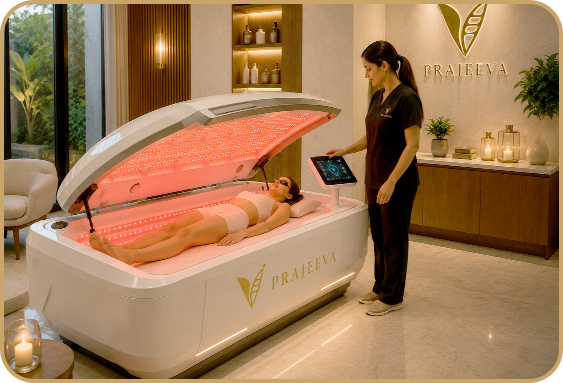
Walk into almost any wellness centre today and you will find a red light panel. The technology is spreading faster than the knowledge of how to use it well. Wavelength, dose, duration, frequency, sequencing with other modalities — all of these variables determine whether a session is therapeutic, sub-therapeutic, or occasionally counterproductive.
At Prajeeva, every photobiomodulation session is preceded by a clinical assessment. Contraindications are reviewed in detail. Protocols are individualised based on current biomarkers, health history and treatment goals. Outcomes are tracked through inflammatory markers, body composition, cognitive battery (where transcranial PBM is part of the protocol) and clinical reassessment.
This is the difference between a wellness experience and a clinical intervention. The technology may look similar from the outside. The intention, the precision, and the accountability are not.
Book a Photobiomodulation Consultation Speak With Our Clinical Team
