 +91-95913-21052
 enquiries@prajeeva.com

 Book
Consultation
Book
Consultation


Ozone Is Oxygen’s More Reactive Cousin. In Medicine, That Reactivity Is Precisely the Point.
Oxygen exists in the atmosphere primarily as O₂ — two oxygen atoms bound together. Ozone (O₃) is three oxygen atoms — an unstable configuration that readily releases its third oxygen atom to react with biological targets. This instability, which makes ozone damaging when inhaled, makes it therapeutically powerful when delivered into the bloodstream in precisely controlled concentrations: it triggers a cascade of antioxidant enzyme upregulation, immune modulation and oxygen delivery enhancement that the body cannot produce on its own.

How Medical Ozone Works -
The Oxidative Preconditioning
Principle
The central mechanism of ozone therapy is oxidative preconditioning — a controlled, carefully dosed oxidative stimulus that activates the body’s own antioxidant defence systems. This is the hormetic principle applied to oxidative biology: a small, controlled amount of oxidative stress triggers a disproportionately large protective response.
When ozonated blood re-enters circulation, the ozone molecules react almost instantaneously with the lipid components of blood plasma, generating lipid oxidation products (LOPs) — specifically hydrogen peroxide and lipid ozonides — at low, controlled concentrations. These LOPs function as biological messengers, activating the Nrf2 pathway — the master regulator of antioxidant gene expression — and triggering upregulation of superoxide dismutase, catalase, and glutathione peroxidase: the body’s three primary antioxidant enzyme systems.
Ozone therapy does not introduce antioxidants. It instructs the body to produce more of its own. This is the distinction between supplementation and biological activation.
The result is a significant, measurable increase in the body’s antioxidant capacity — sustained for days to weeks after each session — alongside improvements in oxygen delivery, immune function and anti-inflammatory signalling.
What Is Major Autohaemotherapy?
The Procedure Explained
Major Autohaemotherapy (MAH) is the standard medical ozone delivery method for systemic effects. The procedure is straightforward, physician-supervised and takes approximately 45–60 minutes :
-
#01
Blood draw
100–200Ml Of The Patient’s Blood Is Drawn Into A Sterile, Anticoagulated Glass Bottle.
-
#02
Ozonation
An Equal Volume Of Medical-Grade Ozone/Oxygen Mixture (At A Precisely Controlled Concentration, Typically 20–40 Μg/Ml) Is Introduced Into The Bottle. The Blood Is Gently Agitated To Ensure Thorough Mixing.
-
#03
Re-infusion
The Ozonated Blood Is Re-Infused Intravenously Via Gravity Drip. The Patient’s Own Red Blood Cells, Now Carrying Modified Oxygen-Delivery Capacity, Return To Circulation.
The Six Mechanisms of Ozone Therapy
Mechanism
Biological Details
Antioxidant Enzyme Upregulation
Ozone-generated LOPs activate Nrf2 → upregulation of superoxide dismutase (SOD), catalase (CAT), glutathione peroxidase (GPx). These are the body’s primary defences against oxidative stress and mitochondrial damage.
2,3-DPG Upregulation
Ozone exposure increases 2,3-diphosphoglycerate in red blood cells — a molecule that regulates haemoglobin’s affinity for oxygen. Higher 2,3-DPG = more efficient O₂ release from haemoglobin to tissues. This is the primary mechanism for ozone’s documented improvement in tissue oxygenation.
Immune Modulation
Ozone stimulates the production of cytokines (IFN-γ, IL-2, TNF-α at low dose) and activates both innate and adaptive immune responses. This is distinct from inflammation — it is immune activation and regulation, which has therapeutic relevance in chronic infections and immune dysfunction.
Antimicrobial Activity
Direct ozone exposure has bactericidal, virucidal and fungicidal activity. In the MAH context, this occurs primarily within the treatment bottle and in circulation during re-infusion, potentially relevant for chronic low-grade infections.
Mitochondrial Stimulation
Low-dose ozone exposure stimulates mitochondrial function via hydrogen peroxide-mediated signalling, complementing the direct mitochondrial effects of NAD+, PBM and HBOT.
Anti-inflammatory Modulation
Through NF-κB pathway regulation and cytokine balance, repeated low-dose ozone exposure produces an anti-inflammatory shift over a treatment course - despite the pro-oxidant mechanism of individual sessions.
MANDATORY SAFETY SCREENING: G6PD (glucose-6-phosphate dehydrogenase) enzyme activity testing is required before ANY ozone therapy or high-dose IV Vitamin C. G6PD deficiency causes haemolysis (red blood cell destruction) when these therapies are administered. This test is non-negotiable at Prajeeva. No ozone treatment proceeds without confirmed normal G6PD activity.

The Evidence Base -
What Ozone Therapy Has Been Demonstrated to Do
Application
Evidence Summary
Grade
Musculoskeletal : Disc Disease
Multiple RCTs demonstrate significant pain reduction and functional improvement in lumbar disc herniation with intradiscal or paravertebral ozone. Systematic reviews support clinical use.
Strong — Grade A/ B
Knee Asteoarthritis
Intra-articular ozone injection RCTs show pain reduction and improved function comparable to corticosteroid injection. Growing clinical adoption in orthopaedics.
Moderate – Grade B
Chronic Fatigue / Fibromyalgia
MAH ozone therapy in controlled studies shows improvement in fatigue scores, pain and quality of life. Mechanistic rationale strong (antioxidant, mitochondrial, immune).
Moderate – Grade B
Chronic Infections
Antiviral and antibacterial mechanisms documented in vitro. Clinical evidence for Hepatitis B/C adjunctive therapy and recurrent infections. Active research area.
Moderate – Grade B
Metabolic and Vascular Health
Documented improvements in lipid profiles, glycaemic control and endothelial function in some clinical series. Mechanistic rationale via antioxidant and mitochondrial pathways.
Emerging - Grade C
Clinical Indications
When Ozone Therapy Is Most Relevant
Ozone MAH at Prajeeva is considered for the following clinical presentations. It is not added by default to any programme — it is selected where the patient’s clinical picture justifies its specific mechanisms.

-
Chronic Fatigue With Inflammatory Or Immune Dysregulation Pattern
when fatigue is accompanied by elevated inflammatory markers, immune dysfunction, or a history of significant viral illness, ozone’s immune modulatory and antioxidant mechanisms address the underlying biology.
-
Post-Viral Illness And Long Covid
the combination of immune activation, antioxidant upregulation, oxygen delivery enhancement and mitochondrial stimulation makes MAH ozone one of the most mechanistically coherent approaches to post-viral fatigue and cognitive impairment.
-
Chronic Musculoskeletal Pain And Inflammation
the strongest evidence base for ozone therapy. Relevant for disc disease, osteoarthritis and other inflammatory joint conditions. Metabolic optimisation — where the patient’s metabolic and inflammatory pattern justifies its inclusion, ozone’s antioxidant and vascular effects can complement the metabolic and mitochondrial corrections achieved by other modalities. Considered selectively, not by default.
-
Immune Support And Recurrent Infections
for individuals with a pattern of frequent or prolonged infections suggesting immune insufficiency, ozone’s immune modulatory properties are clinically relevant.
What Ozone Therapy Is Not - Honest Clinical Positioning

Ozone therapy occupies a contested space in medicine. In some quarters it is promoted as a universal cure for chronic disease, cancer, autoimmunity and ageing — claims that far exceed its evidence base and that Prajeeva explicitly does not endorse. In other quarters it is dismissed entirely as unproven — a characterisation that ignores decades of European clinical use and a growing peer-reviewed literature.
The accurate position is more specific. Ozone therapy has a well-established evidence base for musculoskeletal applications and chronic pain. It has moderate evidence for immune modulation, chronic fatigue and inflammatory conditions. It has emerging evidence for metabolic and post-viral applications. The mechanisms are biological, measurable and well-characterised. It is not a universal treatment. It is a precise clinical tool with defined indications, a specific delivery method and non-negotiable safety requirements.
Prajeeva does not use ozone therapy without a clinical indication, G6PD clearance and a physician-designed protocol. We will not offer it to patients for whom the risk-benefit profile is unclear. Intellectual honesty about evidence is as important as the therapy itself.
Explore Why Prajeeva
Safety, Contraindications and
the G6PD Imperative
Safety Consideration
Clinical Details
G6Pd Deficiency — Absolute Contraindication
G6PD (glucose-6-phosphate dehydrogenase) deficiency causes haemolysis when red blood cells are exposed to oxidative stress. Ozone therapy generates oxidative stress in red blood cells. G6PD enzyme activity testing is mandatory before any session. This is non-negotiable.
Ozone must NEVER be Inhaled
Ozone is a severe pulmonary irritant. MAH delivers ozone exclusively via re- infusion of ozonated blood. Any clinic offering inhaled ozone is operating outside medical safety standards. Prajeeva uses MAH only.
Pregnancy
Avoid. Insufficient safety data. The theoretical risk of oxidative stress to the developing foetus is unacceptable without compelling clinical indication and specialist oversight.
Hyperthyroidism
Active hyperthyroidism is a relative contraindication due to the thyroid’s sensitivity to oxidative stimulation.
Active Haemorrhage
The mild anticoagulant effect of the MAH procedure and the haemodynamic changes contraindicate ozone during acute bleeding.
Recent Myocardial Infarction or Stroke
Avoid within 3 months of MI or stroke (haemorrhagic or ischaemic). Cardiovascular and cerebrovascular stability required before initiating ozone MAH.
Severe Anaemia
Haemoglobin below standard clinical thresholds requires correction before ozone MAH. Reduced red cell mass alters the risk-benefit profile.
ACE Inhibitor Use
Relative contraindication. Potential interaction with ozone’s immune and cytokine effects — reviewed individually at clinical screening.
Active Thromboembolic Disease
Anticoagulation status and active venous thromboembolism require review and clearance before MAH.
Ozone Therapy In The Prajeeva Clinical Protocol

At Prajeeva, ozone MAH is typically delivered as a series of 10 sessions over 4–5 weeks — the minimum necessary to build the sustained antioxidant and immune effects that single sessions do not produce. The protocol is positioned within the broader clinical programme based on the individual’s presenting pattern and specific therapeutic targets.
In the multi-modality sequence, ozone complements HBOT (oxygen delivery enhancement), NAD+ (mitochondrial priming), and PBM (cellular energy restoration) as part of a comprehensive oxidative and energetic restoration programme for patients with chronic fatigue, post-viral illness or complex inflammatory presentations.
Explore Recovery & Regenerative Therapies
A Precisely Controlled Intervention, Not A Trend
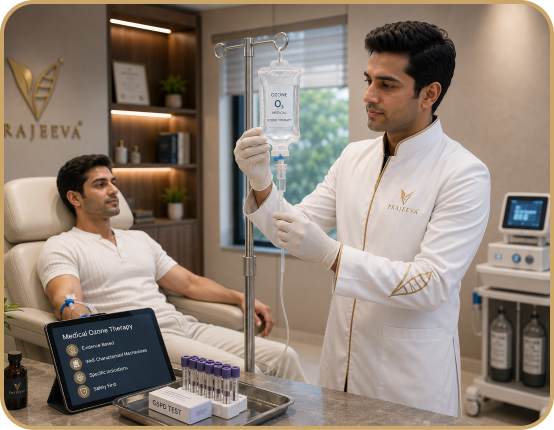
Medical ozone therapy has over 50 years of European clinical history. The evidence base is growing, the mechanisms are well-characterised, the safety requirements are non-negotiable, and the clinical indications are specific. At Prajeeva, it is treated with the same rigour as any other physician-prescribed intervention: indicated by a clinical rationale, delivered by protocol, screened for contraindications, and tracked against defined outcomes.
The G6PD test that every Prajeeva ozone patient receives before their first session is not a formality. It is the standard that distinguishes clinical medicine from commercial wellness.
Begin Your Ozone Therapy Consultation Speak With Our Clinical Team
