 +91-95913-21052
 enquiries@prajeeva.com

 Book
Consultation
Book
Consultation


Understand Your Health
Before Illness Forces You To
Most people do not suddenly become unwell. The body usually starts communicating years earlier — through changes in energy, sleep, recovery, metabolism, stress, cognition and resilience — long before a formal diagnosis is possible. Preventive healthcare is not about waiting for that diagnosis. It is about understanding those earlier changes while there is still time to influence them.

Prevention Begins With
Listening Earlier

The body usually starts giving small signals much earlier than a diagnosis arrives. Sleep stops feeling
restorative. Energy becomes inconsistent. Recovery after stress takes longer. Focus becomes harder to
sustain. Weight begins changing without a clear reason. Blood sugar, blood pressure or inflammation may
slowly move in the wrong direction before symptoms become obvious enough to act on.
These early signs are often ignored because daily life continues normally. People still work, travel,
manage families, attend meetings and complete responsibilities. On paper, everything may appear
acceptable. But internally, the body may already be working harder than it should.
The average time between the onset of measurable biological dysfunction and a formal clinical diagnosis is 7 to 15 years. Most people spend that window believing they are well because their routine tests say so. Prajeeva operates in that window.
Preventive healthcare begins at this stage — identifying what is changing inside the body before illness becomes difficult to manage. Prajeeva’s approach does this through physician-led evaluation, advanced diagnostics, biomarker analysis and personalised health planning built around the individual, not a population average.
Understand What Early Health Signals May Mean
A routine health check-up tells you whether certain numbers are within a standard reference range. It
was
designed to detect disease once it has already crossed a clinical threshold. It was not designed to
detect
the years of biological change that precede that threshold — and that is the gap preventive healthcare
fills.
A person may have blood results that look entirely acceptable and still experience fatigue, poor sleep,
cravings, irritability, weight gain, brain fog or slow recovery after a demanding week. Another may have
a
family history of diabetes, heart disease, dementia or cancer and want to understand their real
biological
risk before symptoms appear. A third may simply sense that something has shifted and want a clinical
explanation.
At Prajeeva, preventive healthcare is not a one-time screening exercise. It becomes a deeper process of understanding how the body is functioning across metabolism, cognition, sleep, stress, recovery, inflammation, hormonal balance and long-term resilience. Here is what that difference looks like in practice :
What Routine Screening Checks
What Prajeeva’s
Assessment Adds
Fasting Glucose + HbA1c
Fasting insulin and HOMA-IR — detecting insulin resistance 7–10 years before HbA1c moves.
Total Cholesterol, LDL, HDL
ApoB and Lp(a) — the cardiovascular risk markers that predict events a decade before standard lipid panels.
TSH for Thyroid
Free T3, Free T4, anti-TPO — the full thyroid picture, not just the trigger hormone.
Standard CRP
hs-CRP, IL-6, homocysteine, fibrinogen — detecting systemic and neurological inflammation.
BMI
Body composition (bioelectrical impedance analysis, BIA) — visceral fat mass, skeletal muscle index and segmental composition. Annual DEXA where bone density assessment is clinically indicated.
Not Assessed
VO₂ max — the single strongest predictor of all-cause mortality. Biological age via epigenetic clock (PhenoAge, GlycanAge, GrimAge as elected).
The goal is clarity, not fear. When people understand what is changing early, they can make better decisions with medical guidance.
The Modern Health Risks
People Often Miss
Modern lifestyles create health risks that do not always appear dramatically in the beginning. High-pressure work culture, poor sleep, constant screen exposure, irregular meals, stress eating, low movement, emotional exhaustion and inadequate recovery quietly influence long-term health in ways that standard tests are not designed to detect.
Many People Notice The Effects Only When They Begin Struggling With Patterns Such As :
-
#01
Waking Up Tired Despite Sleeping Enough.
-
#02
Depending On Caffeine To Feel Functional By Mid-Morning.
-
#03
Gaining Weight Around The Abdomen Despite Eating Carefully.
-
#04
Feeling Mentally Foggy Or Slow By Afternoon.
-
#05
Recovering Slowly From Stress, Travel Or A Demanding Week.
-
#06
Feeling Emotionally Drained Without Any Obvious Illness.
Symptom
Pattern
Likely Biological
Driver
How Prajeeva
Investigates
Tired Despite Sleep
HPA dysregulation, blunted cortisol awakening response, fragmented sleep architecture.
Salivary cortisol curve, sleep study, HRV.
Afternoon Fog And Crash
Post-meal glucose spike and reactive dip, insulin resistance.
14-day CGM, fasting insulin, HOMA-IR.
Abdominal Weight Gain
Chronic cortisol elevation, insulin resistance, visceral fat accumulation.
Body composition (BIA), cortisol, HOMA-IR.
Slow Stress Recovery
Impaired ANS resilience, declining HRV, mitochondrial insufficiency.
HRV baseline, VO₂ max, inflammatory markers.
Emotional Reactivity
Prefrontal-amygdala dysregulation, neuroinflammation, poor sleep architecture.
Sleep architecture, hs-CRP, thyroid panel.
Prajeeva helps individuals connect these signals instead of treating them as separate complaints —
because they rarely are.
Preventive Healthcare
For The Body And The Brain
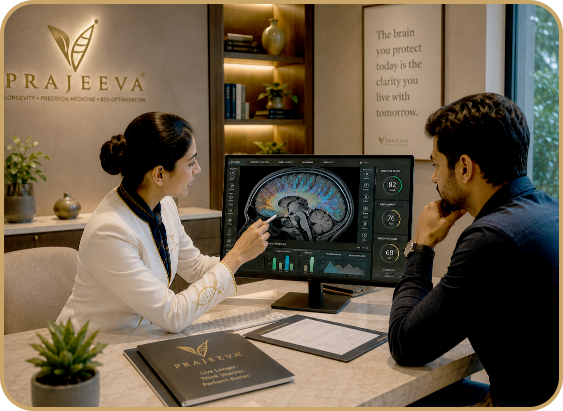
Preventive healthcare is often discussed in relation to heart health, diabetes risk, weight, cholesterol
and routine blood markers. These matter deeply. But they do not complete the picture. The brain also
needs preventive attention — and it is the organ most people have never had clinically assessed.
Many individuals today experience poor concentration, memory lapses, irritability, reduced emotional
resilience or difficulty switching off from work long before they think of these as health concerns. Yet
cognition is closely connected to sleep quality, stress physiology, metabolic health, inflammatory load,
nutritional status and recovery capacity. When these systems are under strain, the brain feels it
measurably.
There is a biological reason for this. The brain consumes 20% of the body’s total oxygen supply despite representing 2% of its weight. It is the most metabolically expensive organ you own. The glymphatic system — the brain’s waste-clearance mechanism — operates almost exclusively during deep slow-wave sleep. When sleep architecture is disrupted, neurotoxic debris accumulates in the brain’s interstitial space. This is not a theoretical future risk. It is a measurable consequence of consistently poor sleep that begins years before any cognitive diagnosis.
Dementia is projected to affect 153 million people globally by 2050. India carries the third-largest burden. The measurable, modifiable biological changes that precede it begin two to three decades earlier. The preventive window is right now.
Prajeeva places cognitive wellbeing within the preventive healthcare conversation. The objective is not only to prevent disease but also to preserve clarity, focus, emotional balance, decision-making ability and long-term brain health. This is especially important for founders, executives, professionals, entrepreneurs, caregivers and anyone whose life depends on sustained mental performance.
Explore Cognitive Optimisation & Brain Health
Preventive healthcare at Prajeeva begins by understanding the person, not only the symptom. Health history, family risks, lifestyle patterns, work pressure, sleep quality, stress load, cognition, emotional wellbeing, nutrition, recovery and long-term goals are all relevant — because all of them shape the biological picture the physician is investigating.
The process is structured, physician-led and outcomes-measured. It is not designed as generic advice. One person may need deeper metabolic and lifestyle correction. Another may need burnout recovery and sleep optimisation. Someone else may need cognitive support, hormonal evaluation or long-term longevity planning.
The Prajeeva Preventive Healthcare Pathway
Phase
What Happens?
Timeline
Physician Consultation
Comprehensive clinical history — three-generation family risk,symptom trajectory,lifestyle, sleep, stress, recovery, goals. Generates the clinical hypotheses thediagnostic panel will answer.
90 mins — Visit 1
Diagnostic Assessment
Targeted biomarker panel matched to the clinical picture. May include metabolic panel (insulin, HOMA-IR, ApoB, Lp(a)), body composition (BIA), VO₂ max, 14-day CGM, sleep analysis, hormonal assessment and biological age testing. G6PD screen included for South Asian patients prior to any advanced therapy.
Visit 1–2
Results And Synthesis
Physician interprets all findings in the context of clinical history. Every result is evidence-graded and communicated in plain language. The pattern tells the story, not the individual numbers. All biomarkers interpreted against South Asian reference ranges.
60–90 mins — Visit 2–3
Protocol Design
Personalised clinical protocol — specific interventions, sequencing, measurable targets and defined reassessment timeline. Success criteria agreed before the protocol begins.
End of Visit 3
Intervention
Physician-supervised programme combining lifestyle medicine, nutritional correction and advanced therapeutic modalities as clinically indicated — HBOT, IV NAD+, ozone MAH therapy (with mandatory G6PD screening), PEMF, photobiomodulation, electric whole-body cryotherapy and infrared sauna.
Weeks 3–16
Outcomes Reassessment
Relevant biomarkers re-measured. Cognitive battery repeated. Body composition reassessed. Objective evidence of what has changed. Protocol graduated or adjusted based on data.
Week 16–18
Long-Term Partnership
Patients requiring sustained longitudinal monitoring may continue through a 12-month rolling partnership — quarterly biomarker reassessment, annual longitudinal report and continuous physician access.
12 months (optional)
Prajeeva’s role is to identify what matters most for each individual and guide the journey with medical
clarity —
not assumption.
Prevention Also Means
Improving What Can Still Be Improved
Preventive healthcare is not only for people who feel completely healthy. It is equally relevant for individuals already experiencing lifestyle-related concerns such as early diabetes risk, hypertension, chronic stress, poor sleep, weight gain, burnout, fatigue, metabolic imbalance or declining focus.
Many people assume that once a condition is present, the only path forward is lifelong management. In reality, several lifestyle-driven health concerns can improve significantly — or enter remission — when the underlying biological drivers are identified and addressed while the window is still open.
What the Evidence Shows Is Reversible
Condition/ Pattern
What Evidence Supports?
Strengths
Type 2 Diabetes (Early, <5 Years)
Remission achievable in 40–60% of cases with structured metabolic and lifestyle correction addressing insulin resistance.
Strong — Grade A
Metabolic Syndrome
Significant reversal of all five diagnostic criteria in the majority of patients with physician-led protocol.
Strong — Grade A
Non-Alcoholic Fatty Liver (NAFLD)
Measurable regression on imaging with sustained metabolic correction. Affects approximately 38% of Indian adults.
Strong — Grade A
HPA Dysregulation / Burnout
Measurable cortisol curve improvement over 3–6 months with structured recovery protocol.
Moderate — Grade B
Subclinical Hypothyroidism
Symptom improvement and in some cases normalisation when nutritional drivers (selenium, iodine, iron) are addressed.
Moderate — Grade B
PCOS (Metabolic Phenotype)
Cycle regularity and androgen normalisation in the majority when insulin resistance is the primary driver.
Moderate — Grade B
Prajeeva’s Philosophy Is Clear :
- Treat The Cause, Not Just The Symptom.
- Reverse What Can Be Reversed.
- Prevent What Can Be Prevented.
This approach requires medical guidance, consistency, diagnostics, lifestyle correction, recovery support and measurable follow-up. It is not about shortcuts. It is about helping the body move in a better direction while there is still meaningful opportunity to act.
Explore Functional MedicineBuilt For People Who Want To
Take Health Seriously
Prajeeva is designed for individuals who do not want to wait until health becomes an emergency. It is for people who want to understand their body more deeply, act earlier, age better, recover better and preserve physical and cognitive wellbeing over time.
It may be right for someone who feels “not unwell, but not fully well either” — and wants a clinical explanation for why. It may be right for someone with a family history of chronic disease who wants to act in the window when action produces the greatest return. It may be right for a leader who wants sharper cognition and better stress recovery. It may be right for someone entering their 30s, 40s, 50s or beyond who wants a more intelligent, measurable relationship with their health.
-
#01
You Feel Tired, Mentally Slower Or Less Resilient Than You Did A Few Years Ago — And Routine Tests Show Nothing.
-
#02
You Carry A Family History Of Cardiovascular Disease, Diabetes, Dementia Or Cancer And Want To Know Your Real Biological Risk.
-
#03
You Have Been Managing A Chronic Condition And Want To Understand What Can Still Be Improved Alongside Current Treatment.
-
#04
You Are A Professional, Founder Or Executive Whose Quality Of Life Depends On Sustained Cognitive Performance And Recovery.
-
#05
You Want To Know Your Biological Age, Understand The Gap From Your Chronological Age And Close It With A Targeted Protocol.
-
#06
You Simply Want Healthcare That Measures More, Assumes Less And Explains Clearly.
and acting while the biology is still on your side.

