 +91-95913-21052
 enquiries@prajeeva.com

 Book
Consultation
Book
Consultation


Know What Your Body Is Saying Before Symptoms Become Loud
Standard reports are designed to detect disease once it is already present. They are not designed to
detect the years of biological change that precede it. The gap between “not yet sick” and “functioning
well” is real, measurable — and almost entirely invisible to routine screening.
Prajeeva’s advanced
diagnostics programme investigates that gap. Using a physician-led, biomarker-driven approach, we
identify functional decline before it becomes a formal diagnosis — giving you the clarity to act while
change is still possible.

Reports Are Useful.
Interpretation Makes Them Meaningful.
Many people today already undergo routine blood tests, annual health check-ups, and diagnostic screenings. Yet after receiving their reports, they are often left with a familiar uncertainty: the numbers may look acceptable, but the person still does not feel fully well. Here is a scenario that Prajeeva physicians encounter regularly.
A 42-year-old executive presents with fatigue that has worsened over 18 months, poor sleep quality, increasing abdominal weight despite a largely unchanged diet, afternoon energy crashes, and a feeling of being mentally slower than she used to be. Her most recent annual health check — full blood count, liver function, kidney function, thyroid, fasting glucose, lipid panel — was entirely within reference range. She was told she was fine.
She is not fine. She has early insulin resistance measurable through fasting insulin and HOMA-IR. Her hs-CRP points to low-grade systemic inflammation. Her free T3 is at the lower end of “normal” despite a normal TSH. Her cortisol awakening response is blunted. Her ApoB is elevated despite an apparently acceptable LDL. None of these findings trigger a formal diagnosis. All of them explain exactly why she feels the way she does. And all of them are addressable — but only if they are measured.
At Prajeeva, diagnostics are not treated as isolated data. They are interpreted in the context of the person’s health history, lifestyle, stress load, sleep quality, recovery pattern, metabolic condition, cognitive wellbeing, and long-term goals. A report can show a number. A physician-led interpretation helps explain what that number may mean for the person.
Advanced Diagnostics Look Beyond Routine Screening

Routine health screening has a defined purpose: detect serious disease that warrants immediate treatment. It does this reasonably well. What it was never designed to do is detect early functional decline — the metabolic, inflammatory, hormonal, and neurological shifts that develop over years before they cross a diagnostic threshold.
Advanced diagnostics extends the view into that pre-diagnostic window. The question changes from “Do you have disease X?” to “How are the biological systems that prevent disease X actually functioning right now?”
Advanced diagnostics help create a deeper picture of how the body is functioning across multiple systems. This may include metabolic health, cardiovascular risk, inflammation, hormone balance, nutrient status, sleep-related patterns, body composition, cognitive function, recovery capacity, and biological ageing.
The purpose is not to make healthcare complicated. The purpose is to make it clearer. When the right markers are studied together, they can help reveal why a person feels tired despite rest, why weight is changing despite effort, why focus is declining, why recovery is slower, or why stress is affecting the body more deeply than before.
Explore Biological Ageing & Longevity MedicineBiomarkers Help
Connect The Dots
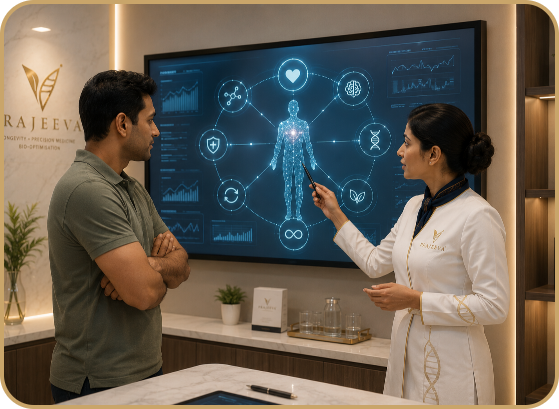
A biomarker is a measurable signal that offers insight into what may be happening inside the body. But
no biomarker should be understood in isolation. Biomarkers are only as useful as the clinical logic
behind them. A single number rarely tells the full story.
In context, it is a clinical signal.
Prajeeva’s diagnostic approach is built around pattern recognition — understanding what multiple markers
are saying together, in the context of your symptoms, history, and physiology.
For example, fatigue may involve sleep quality, inflammation, iron levels, thyroid function, blood sugar control, stress hormones, nutrition, or recovery load. Brain fog may involve poor sleep, metabolic instability, emotional stress, nutrient gaps, inflammation, or nervous system overload. Weight gain may involve insulin resistance, hormonal shifts, sleep disruption, stress eating, reduced muscle mass, or poor recovery. This is why biomarker analysis becomes valuable when it is connected to real-life symptoms and medical interpretation.
At Prajeeva, biomarker analysis helps physicians understand patterns across areas such as metabolic health, inflammation, hormone balance, nutrient status, cardiovascular resilience, recovery, cognitive wellbeing, and longevity risk.
The diagnostic panel for each individual is selected based on the presenting clinical picture, health history, and the specific hypotheses the physician is investigating. Every marker ordered should either confirm or redirect the clinical reasoning.
Useful Biomarkers May Help Answer Questions Such As :
-
#01
Why Is Recovery Slower Than Before?
-
#02
Why Does Sleep Not Feel Restorative?
-
#03
Why Is Focus Declining Despite Normal Routines?
-
#04
Why Is Energy Unstable Through The Day?
-
#05
Why Is Weight Changing Despite Effort?
-
#06
What Early Risks Need Attention Now?
Metabolic Disease Starts Silently. The Biomarkers Do Not.

Metabolic health is one of the most important foundations of preventive healthcare. When metabolism begins changing, the early signs are not always dramatic.
For example, type 2 diabetes does not appear overnight. It develops over 10–15 years, progressing through stages of insulin resistance that are measurable, clinically significant, and largely reversible — but only if they are identified before they cross the HbA1c threshold that triggers a formal diagnosis.
By the time HbA1c is elevated, a person has typically carried significant insulin resistance for years. The metabolic machinery has already been under strain. Vascular damage may have already begun. The diagnostic window for the highest-leverage intervention has passed. Prajeeva’s metabolic assessment identifies this pattern at its earliest measurable stage.
Advanced diagnostics and biomarker analysis can help identify early metabolic patterns before they become more difficult to manage. This may include understanding blood sugar regulation, insulin response, inflammation, lipid patterns, body composition, liver health, muscle mass, and lifestyle-related risk.
Prajeeva uses this information to help individuals move beyond generic advice. Instead of simply saying “eat better” or “exercise more,” the focus is on understanding what the body actually needs based on its current biological signals.
Explore Metabolic Health & Lifestyle MedicineCognition Also Has Biological Signals
Brain health is often discussed only when memory concerns or focus problems become noticeable. A professional notices they are re-reading sentences. An executive finds that decisions that used to feel instinctive now require more effort. A parent notices their patience threshold has narrowed. None of this registers in a routine health check.
Poor concentration, mental fatigue, emotional irritability, reduced memory, difficulty switching off, and low motivation may be connected to sleep quality, metabolic health, inflammation, nutrient status, stress physiology, hormonal balance, and nervous system recovery. These are not inevitable consequences of a busy life. They are measurable biological patterns with identifiable drivers — and in most cases, addressable ones.
This is why cognitive optimisation at Prajeeva is supported by diagnostics and biomarker understanding. The aim is not to treat brain health as a separate or abstract concern, but to understand how the body and brain are functioning together. For anyone operating at high cognitive demand — physician, founder, executive, researcher, caregiver — this is not an abstract health aspiration. Sustained cognitive performance depends not only on discipline or productivity habits, but also on recovery, sleep, emotional regulation, metabolic stability, and long-term brain health. The biological state of your brain directly determines the quality of your decisions, your stress resilience, and your long-term professional function. Prajeeva treats it as the clinical priority it is.
Explore Cognitive Optimisation & Brain HealthRecovery Is A Clinical Metric, Not A Lifestyle Preference
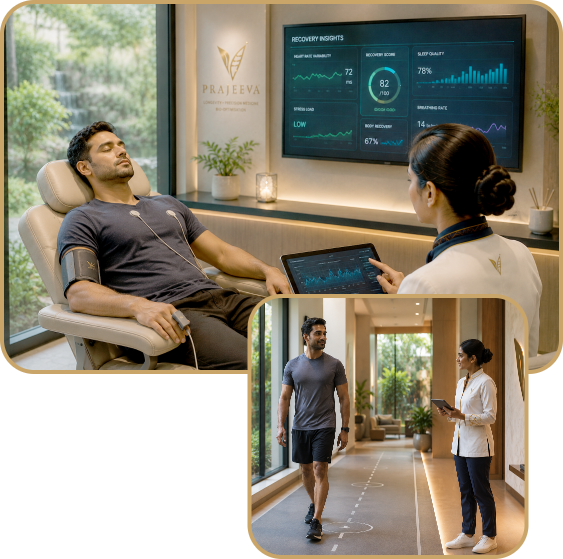
Recovery capacity is arguably the most revealing single indicator of overall physiological resilience. How quickly does your nervous system return to baseline after a stressful day? How rapidly does your muscle tissue repair after physical exertion? How many nights of disrupted sleep does it take before your cognition is measurably impaired?
If stress stays in the body longer than before, if travel causes prolonged fatigue, if workouts create extended exhaustion, if sleep does not restore energy, or if emotional strain takes days to recover from, the body may be showing signs of reduced resilience.
Declining recovery is not a sign of ageing. It is a sign of biological systems under strain — and it is one of the earliest measurable signals that the body is carrying an unsustainable load. Many people judge health by how much they can do. Prajeeva looks closely at how well the body recovers after doing it. Advanced diagnostics can help explore what may be influencing recovery. This may involve inflammation, nutrition, sleep quality, hormonal balance, cardiovascular fitness, metabolic health, nervous system load, or mitochondrial function.
Prajeeva’s approach connects diagnostics with lived experience. The question is not only what the report says. The question is whether the person’s body still has the capacity to return to balance effectively.
Explore Recovery & Regenerative Therapies
Diagnostics Are The Starting Point, Not The Whole Journey

A detailed report can be valuable, but it is not the destination. The real value comes from what happens after the results are understood .One of the genuine failures of the “premium diagnostics” industry is that it stops at the report. A 50-page PDF of biomarkers is delivered, the person stares at 200 values they do not understand, and nothing changes.
At Prajeeva, the diagnostic report is the entry point to a physician-led clinical conversation — not the destination.
Results are interpreted, priorities are identified, and care pathways are shaped around the individual’s health risks, symptoms, goals, lifestyle, and long-term wellbeing. One person may need metabolic correction. Another may need sleep and recovery work. Someone else may require cognitive-health support, hormonal evaluation, nutritional correction, functional medicine guidance, or longevity planning.
The goal is to help individuals move from uncertainty to clarity.
Begin Your Advanced Diagnostic Assessment

What To Expect: Prajeeva’s Diagnostic Philosophy In Plain Language
Three principles govern how Prajeeva approaches diagnostics. They are worth stating directly.


