 +91-95913-21052
 enquiries@prajeeva.com

 Book
Consultation
Book
Consultation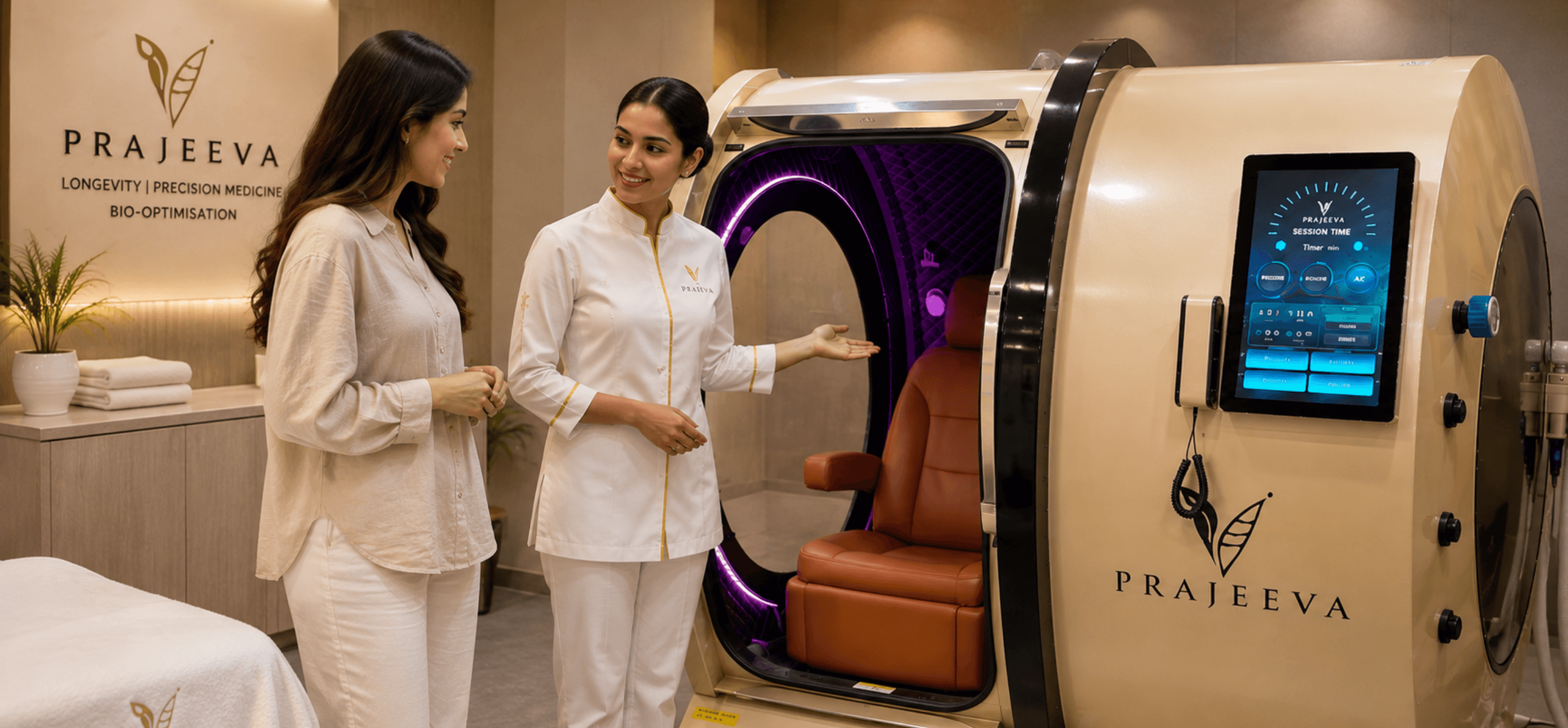


Your Body Runs on Oxygen.
Most People Are Running on Empty.
You breathe roughly 20,000 times a day — yet most people never stop to ask whether their cells
are truly
receiving enough oxygen to repair, recover and perform. Hyperbaric Oxygen Therapy (HBOT) changes
that
equation entirely.
At Prajeeva, HBOT is not a trend session to be booked between meetings. It is a
physician-guided, evidence-anchored intervention — placed within a personalised clinical pathway
designed around your recovery, your brain and your long-term performance.

Why Oxygen Is The Most
Underestimated Molecule In Your Body
Here is something most people do not know: you can breathe perfectly well — lungs working, blood circulating, oxygen saturation at 98% on a pulse oximeter — and still have tissues quietly starved of the oxygen they need. Under normal atmospheric conditions, oxygen travels through the body primarily locked to haemoglobin in red blood cells. That system is efficient — but it has a ceiling. Once haemoglobin is fully saturated, breathing more does not deliver more oxygen. The body’s delivery infrastructure has reached its limit.
This is why people who sleep well, exercise regularly and eat carefully still experience brain fog, slow recovery, persistent fatigue and reduced resilience after illness, stress or intense exertion. The oxygen is in the blood — but it is not reaching the tissues that need it most.
Think of your body’s oxygen delivery as a highway system. Haemoglobin is the bus — reliable, but limited by its seats. HBOT floods the highway with oxygen dissolved directly into plasma — no seat required. Even the smallest capillaries, the roads no bus can reach, now carry fuel.
Oxygen plays a central role in ATP energy production, tissue repair, immune response, inflammation resolution, neurological function and the regulation of gene expression. When the body carries chronic stress, recovers from illness, or manages the demands of a high-performance life, oxygen demand quietly outpaces supply.
What Is Hyperbaric Oxygen Therapy?
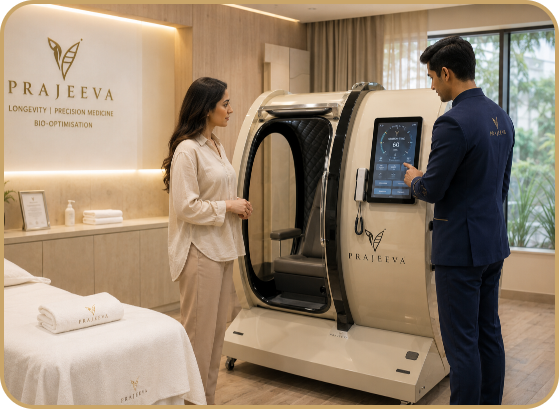
HBOT involves breathing 100% medical-grade oxygen inside a pressurised chamber — typically at 1.5 to 2.0 atmospheres absolute (ATA), the equivalent of descending 5 to 10 metres below the ocean surface. At that pressure, oxygen stops being a passenger to haemoglobin and begins dissolving directly into blood plasma, cerebrospinal fluid and lymphatic fluid — reaching tissues that normal circulation cannot reliably supply. Dissolved oxygen availability to tissues can increase by more than tenfold under these conditions.
The session itself is straightforward. You enter Prajeeva’s state-of-the-art HBOT chamber, the pressure builds gradually over a few minutes, and you breathe normally for around 60 minutes while the body undertakes cellular repair. Most people watch television, listen to music, read or simply rest. Our chamber accommodates two people simultaneously — you can share the experience with a partner or friend. Many leave feeling noticeably clearer and lighter.
The Science Behind the Pressure
Mechanism
What Happens?
Hyperoxic-Hypoxic Paradox
Repeated bursts of high oxygen followed by normal breathing trigger the body’s low-oxygen response pathways — stimulating stem cell release, VEGF (vascular growth factor) production and HIF-1α signalling. The body responds to oxygen abundance the same way it responds to oxygen shortage: by building more capacity.
Angiogenesis
HBOT stimulates new blood vessel formation, rebuilding the microvascular networks that chronic stress, ageing and inflammation progressively erode — new supply routes built into tissues that were previously starved.
Stem Cell Mobilisation
Research by Thom et al. (2006) demonstrated that HBOT doubles circulating stem cell concentration in the bloodstream. These master cells migrate to sites of injury or dysfunction, facilitating tissue repair and cellular renewal.
Neuroplasticity & Brain Recovery
HBOT increases cerebral blood flow and supports neuroplasticity. Efrati et al. (2020) demonstrated significant improvements in attention, processing speed and executive function in healthy ageing adults following a 60-session HBOT protocol.
Telomere Lengthening
The same 2020 research showed 60 HBOT sessions increased DNA telomere length by 20–38% in blood cells — among the first human evidence of improvement in a core biological ageing marker. Senescent cells also decreased by up to 37%.
Mitochondrial Biogenesis
HBOT stimulates cells to build new energy-producing mitochondria. More mitochondria means more cellular energy, faster recovery and greater resilience.
The Difference Between Booking A Session
And
Beginning
A
Protocol
HBOT is not a passive experience. It is a physiological intervention. The pressure changes how oxygen behaves in every tissue of your body, activating biological cascades — stem cell release, angiogenesis, neuroplasticity — that are powerful precisely because they are real.
Certain contraindications require careful physician screening: active ear or sinus conditions, untreated pneumothorax, specific medications and cardiac history must all be evaluated before any HBOT exposure. A session that feels restorative to one person can create real clinical risk for another without the right filter in place.
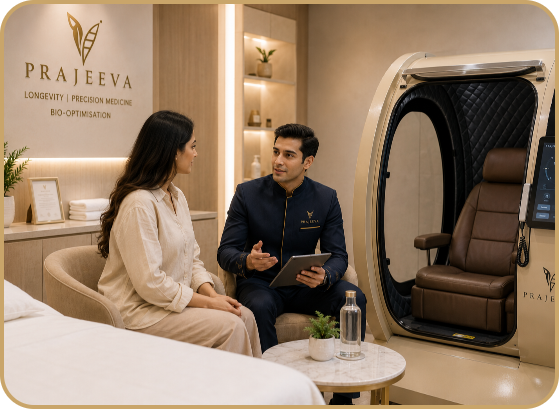
At Prajeeva, every HBOT journey begins with a physician assessment — not a booking form. Your health history, current biomarkers, recovery patterns and performance goals are reviewed before a single protocol recommendation is made.
Explore Physician-Led Recovery Care at Prajeeva
Recovery : The First Place
Most People Notice The
Difference
Think about the last time your body surprised you with how long recovery took. A demanding week at work. A long-haul flight. An illness that left you depleted for weeks. A training session that took far longer to bounce back from. These are not signs of weakness — they are signs that recovery bandwidth is narrowing.
For most high-functioning individuals, the decline in recovery capacity is gradual and largely invisible until it becomes undeniable. The body adapts. And one day you realise the version of you from five years ago recovered faster, thought more clearly and bounced back harder.
HBOT directly addresses the biological mechanisms underlying slow recovery: tissue hypoxia, systemic inflammation, mitochondrial dysfunction and compromised microvascular supply. By flooding tissues with dissolved oxygen under pressure, HBOT accelerates the cellular repair cycle and helps restore baseline resilience.
Who Experiences This Most Clearly?
-
#01
Professionals Carrying Sustained Cognitive And Physical Load
-
#02
Frequent Long-Distance Travellers Experiencing Jet Lag And Immune Suppression
-
#03
Individuals Recovering From Viral Illness, Surgery Or Overtraining
-
#04
People With Persistent Fatigue That Does Not Resolve With Rest Alone
-
#05
Active Individuals Seeking Faster Turnaround Between Training Cycles
Recovery support through HBOT is contextualised at Prajeeva within a full clinical picture: sleep quality, inflammation markers, metabolic health, nutrition and stress physiology are all considered. The goal is to understand why the body is not restoring itself at the rate it should — and build a protocol that addresses the real cause.
Your Brain Consumes 20% of Your Oxygen. Is It Getting Enough?

The brain represents roughly 2% of your body weight yet demands approximately 20% of your entire oxygen supply. It is the most metabolically expensive organ you own — and the first to show strain when recovery fails, inflammation rises or oxygen delivery becomes inconsistent. Cognitive fatigue rarely announces itself dramatically. It arrives quietly: the afternoon when concentration begins to slip, the meeting where you are physically present but mentally elsewhere, the growing impatience you cannot fully explain, the sleep that no longer restores. These are not personality changes. They are physiological signals.
HBOT has emerged as one of the most rigorously studied non-pharmaceutical interventions for brain health. The landmark Efrati et al. (2020) study at the Sagol Center for Hyperbaric Medicine, Tel Aviv, demonstrated that 60 HBOT sessions in healthy ageing adults produced measurable improvements in attention, processing speed and executive function — the cognitive domains most vulnerable to ageing and chronic stress.
The mechanism is multifactorial: increased cerebral blood flow through angiogenesis, reduced neuroinflammation, improved mitochondrial function in neurons and activation of neuroplasticity pathways. This is not cognitive enhancement through stimulation. It is cognitive restoration through repair.
Explore Cognitive Optimisation and Brain Health

Who Is HBOT For?
HBOT is not appropriate for everyone — and at Prajeeva, physician evaluation is not a formality. It is the clinical foundation that makes this therapy safe, targeted and genuinely effective.
As part of a broader clinical protocol, HBOT has demonstrated consistent value for :
Profile
Why HBOT Helps?
High-performing Professionals
Managing sustained cognitive and physical load, chronic stress, reduced recovery windows and brain fog.
Executives & Frequent Travellers
Dealing with immune suppression, jet lag, disrupted sleep and elevated cortisol from continuous high-stakes environments.
Active Individuals & Athletes
Seeking measurably faster tissue repair, reduced downtime between training cycles and sustained physical output.
Individuals Post-Illness
Recovering from Long COVID, surgery, viral illness or any condition leaving residual fatigue, cognitive impairment or tissue damage.
Those Investing in Longevity
Proactively addressing biological ageing markers — telomere health, cellular senescence, mitochondrial function — before symptoms arrive.
People with Chronic Conditions
Under appropriate physician supervision, HBOT may support management of inflammatory, metabolic and neurological conditions.
Certain medical histories require caution or specific protocol modification: recent ear or sinus surgery, uncontrolled hypertension, active malignancy without oncologist clearance, claustrophobia and specific cardiorespiratory conditions. Prajeeva’s physician review process identifies these precisely and either adapts the protocol or recommends alternative pathways.
Check If HBOT Is the Right Fit for YouHow HBOT Fits Into The
Prajeeva Clinical Protocol
Prajeeva operates on one principle: every therapy must earn its place in a protocol — not because it is trending, but because it is the right tool for this person, at this moment, for this specific physiological objective. Within Prajeeva’s multi-modality clinical programme, HBOT occupies the oxygen-loading phase. Where clinically appropriate, the full protocol is sequenced in physiological order:
The Sequential Logic
-
#01
IV NAD+ Infusion
Cellular Energy Currency Restoration — Priming Mitochondria
-
#02
Infrared Sauna
Vascular Priming — Increased Circulation And Heat Shock Protein Activation
-
#03
PEMF Therapy
Membrane Optimisation — Cellular Voltage And Ion Channel Activation
-
#04
HBOT
Oxygen Loading — Deep Tissue Saturation And Regenerative Cascade Activation
-
#05
Red Light Therapy
Mitochondrial Amplification — Cytochrome C Oxidase Stimulation
-
#06
Cryotherapy
Hormetic Closing — Anti-Inflammatory Reset, Norepinephrine Activation, Resilience Stimulus
These modalities are sequenced by a physician across a personalised programme according to each patient’s biology, goals and clinical tolerance — not delivered as a fixed package. HBOT is a precision instrument deployed at the moment when the body is most prepared to respond.
Explore Advanced Diagnostics and Biomarker AnalysisYour Protocol. Your Biology. Your Outcomes.
No two bodies carry stress the same way. No two nervous systems recover on the same schedule. No two brains respond identically to sleep deprivation, inflammation or cognitive overload. This is a biological fact — and it is why the idea of a standard HBOT package is, at best, an approximation.
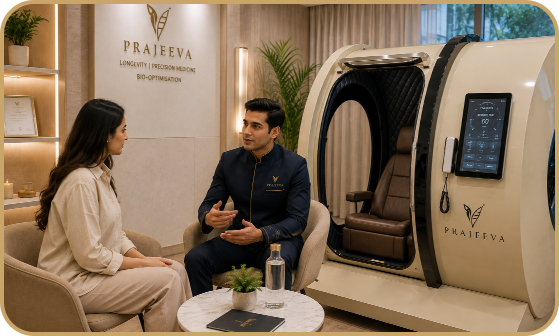
At Prajeeva, HBOT protocols are determined by physician assessment and adjusted in response to individual response. Session count, pressure protocol, duration and sequencing alongside other modalities are all personalised. Your protocol is built from:
- Current Biomarkers And Health Diagnostics
- Cognitive And Physical Performance Objectives
- Sleep Quality, Hrv And Recovery Metrics
- Medical History And Contraindication Screening
- Metabolic Health, Inflammatory Load And Hormonal Status
- Lifestyle Factors: Stress, Nutrition, Movement And Environment
The goal is not a completed course of sessions. The goal is a measurably improved physiological baseline — one that holds beyond the clinic, shapes how you feel at work, how quickly you recover from challenge and how sustainably you perform over time.
Begin Your HBOT Consultation Speak With Our Medical Team
