 +91-95913-21052
 enquiries@prajeeva.com

 Book
Consultation
Book
Consultation


Recovery Is Not Rest Alone.
It Is the Biology of Repair.
Many people continue working, exercising, travelling, leading teams and managing responsibilities while their ability to recover slowly weakens. Rest stops the input. Recovery rebuilds the system. They are not the same thing — and confusing them is one of the most common reasons high-functioning people remain chronically under-recovered despite sleeping, taking holidays and reducing workload.

Many People Do Not Realise Their
Recovery Has Changed
Recovery often weakens quietly. A person may still complete work, manage responsibilities, travel, attend meetings and maintain a normal routine — but the body begins taking longer to return to balance. The body has remarkable adaptive capacity. When recovery becomes impaired, it adapts rather than complains — redistributing resources and maintaining surface performance while quietly degrading the underlying systems.
The warning signs are there, but they are easy to dismiss. A demanding week feels heavier than before. Sleep does not restore energy the way it once did. Exercise creates longer fatigue. Travel leads to more exhaustion than expected. The week that takes until Wednesday to shake off instead of Monday. The illness that should have resolved in a week takes three. The workout that should have been manageable leaves you sore for days. Emotional stress stays in the body longer. These are not random events. They are measurable biological signals that the recovery system is under strain.
Recovery capacity is the single most reliable indicator of overall physiological resilience. When it declines, every system in the body eventually follows.”
Prajeeva approaches recovery as a serious part of preventive healthcare. The focus is not simply on helping people feel temporarily relaxed. The aim is to understand why recovery has weakened and how the body can be supported through physician-led care, diagnostics, lifestyle correction and suitable recovery-focused therapies.
Recovery Connects
Multiple Biological Systems
Recovery is not controlled by one system alone. It is a multi-system biological process influenced by sleep quality, stress physiology, nervous system balance, metabolic health, inflammation, nutrition, hormones, oxygen utilisation and physical conditioning. This is why two people may respond very differently to the same lifestyle pressure — one recovers after a night’s sleep, another needs days to feel normal after stress, travel or intense work. The difference lies in the health of the following systems.
System
What Declining Recovery Looks Like
Autonomic Nervous System
HRV measures how efficiently your ANS shifts from sympathetic (stress) to parasympathetic (repair) mode. Chronic stress, poor sleep and inflammation impair this transition — measurably. Declining HRV over weeks is one of the earliest signals of physiological overload.
Mitochondrial Function
Every cell’s energy currency (ATP) is produced by mitochondria. When mitochondrial density or efficiency declines — from chronic stress, ageing, poor sleep or nutrient depletion — physical and cognitive recovery slows, and fatigue becomes baseline rather than temporary.
Sleep Architecture
Deep slow-wave sleep triggers growth hormone secretion, tissue repair and glymphatic brain clearance. REM sleep consolidates memory and emotional processing. Without both in sufficient proportion, recovery is fundamentally Incomplete regardless of total sleep hours.
HPA Axis
After a cortisol surge, the cortisol curve must return to baseline by evening and rebuild overnight. A blunted cortisol awakening response and elevated evening cortisol are the biological signature of burnout — measurable by salivary cortisol testing.
Inflammatory Clearance
Post-exertion and post-stress inflammation must be resolved efficiently. When chronic background inflammation (elevated hs-CRP, IL-6) is already present, resolution is impaired and recovery slows proportionally. Inflammation and recovery exist in a direct feedback loop.
Nutritional Substrates
Magnesium, CoQ10, B vitamins, iron and omega-3s are all consumed in recovery processes. Subclinical depletion — common in high-performing adults and rarely caught on standard panels — directly limits cellular repair capacity.
At Prajeeva, recovery care begins by understanding the person behind the fatigue. The goal is to help the body regain its ability to return to balance more effectively — not through generic rest, but through physician-guided restoration of the specific systems showing the greatest deficit.

Regenerative Therapies
Must Serve A Clear Purpose
Regenerative and recovery-focused therapies are becoming increasingly visible. People are hearing about HBOT, red light therapy, PEMF, cryotherapy, infrared sauna, IV NAD+ and ozone therapy. The challenge is that many encounter these as standalone sessions rather than as part of a medically guided health pathway — presented as experiences to be booked rather than interventions to be prescribed.
Prajeeva takes a different view. A therapy should not be used because it is new, premium or popular. It should have a clinical reason. It should have a defined mechanism, a supporting evidence base, a clinical indication and a contraindication list. It should fit the person’s health condition, recovery needs, diagnostics and long-term goals. Every therapy at Prajeeva is offered because a physician has reviewed the patient’s specific biology and determined it belongs in their protocol.
Modality
Clinical Rationale
HBOT (2.0 ATA)
Dissolves oxygen directly into plasma at tenfold normal concentrations. Drives angiogenesis, stem cell mobilisation, telomere lengthening, neuroplasticity and mitochondrial biogenesis. G6PD screening mandatory before use.
IV NAD+
Restores the cellular energy coenzyme that declines approximately 50% between ages 20 and 60. Essential for DNA repair, sirtuin activation and mitochondrial function. IV delivery bypasses gastrointestinal absorption limits.
Photobiomodulation (Red Light / Near-Infrared)
Stimulates cytochrome c oxidase in mitochondria, increasing ATP production. Evidence base covers muscle recovery, neuroinflammation reduction and cognitive function support.
PEMF Therapy
Pulsed electromagnetic fields restore cellular membrane potential and ion channel function. Anti-inflammatory, supports cellular repair, sleep quality improvement and nervous system regulation.
Infrared Sauna
Cardiovascular conditioning effect, heat shock protein activation and heavy metal mobilisation. Regular sauna use is associated in long-term Finnish cohort data with approximately 40% reduction in cardiovascular mortality and substantial dementia risk reduction.
Electric Whole-Body Cryotherapy
Modern electric cryochamber (not nitrogen-cooled) at sub-zero temperatures. Reduces pro-inflammatory cytokines, activates norepinephrine (improving mood, focus and vigilance) and triggers hormetic adaptation for resilience.
Ozone Therapy (MAH)
Medical ozone via Major Autohaemotherapy. Upregulates antioxidant enzymes, improves tissue oxygen utilisation and modulates immune response. G6PD enzyme activity testing mandatory prior to treatment given higher prevalence of G6PD deficiency in South Asian populations.
When the Body Needs More Than Rest to Recover
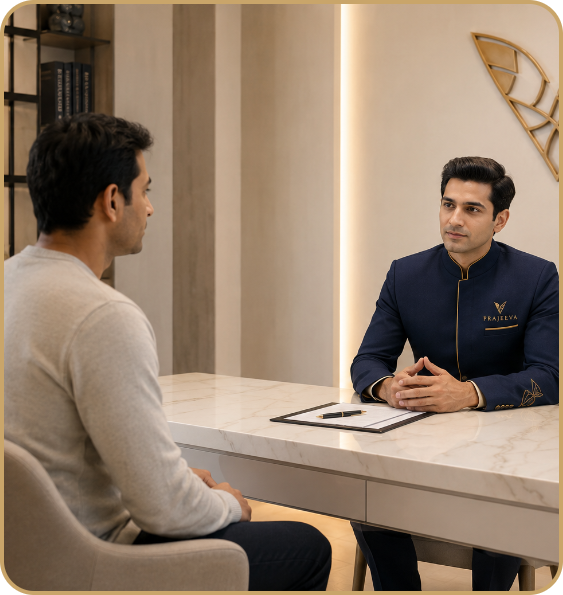
Some people seek recovery support after years of pushing through fatigue — already trying hard but still not restoring — so consistently that they have forgotten what genuine restoration feels like. Others come after a discrete event: a viral illness that never fully resolved, a period of extreme professional pressure, a surgery with a longer recovery than expected or a training programme that produced diminishing returns instead of improvement.
Recovery needs may look different for different people. Someone may feel physically drained but mentally restless. Another may feel emotionally flat. Someone else may struggle with persistent muscle soreness, poor sleep, low energy or slow recovery after exertion. What is common across all of them is that standard rest — sleep, holidays, reduced workload — is no longer sufficient. The recovery system itself has been damaged, depleted or dysregulated beyond what passive rest can restore.
This is precisely the clinical indication for physician-supervised regenerative therapy. Not as a wellness experience, but as a targeted biological intervention designed to restore the specific systems that passive rest cannot reach: mitochondrial density, vascular microcirculation, stem cell availability, neuroplasticity, HPA axis regulation and cellular repair capacity. Every pathway at Prajeeva is guided by medical context rather than generic wellness assumptions.
Recovery Is Important for
Cognitive Health Too
Many people think of recovery only in physical terms. But the brain also needs active recovery — and it is the dimension of recovery that is most consistently underestimated. The brain consumes 20% of the body’s total oxygen supply despite representing 2% of its weight. It is the most metabolically expensive organ in the body and the most sensitive to inadequate recovery. A person may complete a normal workday but feel mentally unavailable by evening. They may struggle to switch off even when tired, feel emotionally reactive, forgetful or unable to focus after prolonged stress. These are recovery signals.
The glymphatic system — the brain’s waste-clearance mechanism — is active almost exclusively during deep slow-wave sleep. When sleep is fragmented or deep sleep is suppressed by alcohol, late screen exposure, cortisol dysregulation or sleep apnoea, amyloid-β and tau protein accumulate in the brain’s interstitial space. This is not a theoretical future risk. It is a measurable current reality in people whose sleep is consistently impaired.
This is why cognitive recovery is addressed directly through Prajeeva’s regenerative modalities. For example, HBOT increases cerebral blood flow and supports neuroplasticity. IV NAD+ addresses the energy deficit that underlies cognitive fatigue through sirtuin-mediated DNA repair in neurons. Photobiomodulation stimulates cytochrome c oxidase in brain mitochondria and is the subject of growing research in neurodegenerative prevention.
Recovery For
Modern High-Pressure Lives
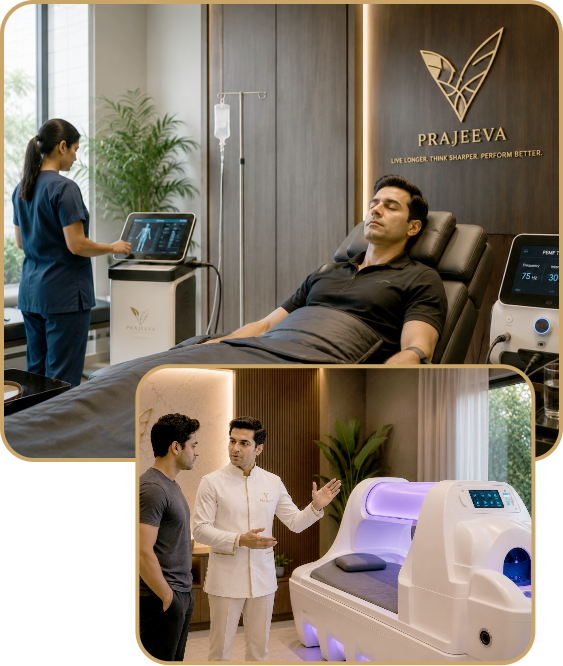
Modern life often rewards output more than recovery. Long workdays, screen exposure, constant availability, travel, irregular meals, emotional pressure and poor sleep can gradually create a body that continues functioning but no longer restores itself properly. Constant connectivity collapses the boundary between sympathetic arousal and parasympathetic repair. Artificial light suppresses melatonin and delays sleep onset. Chronic time pressure elevates cortisol continuously. Sedentary work reduces the anti-inflammatory myokine production that normally follows physical activity.
This is especially relevant for founders, executives, professionals, caregivers and individuals managing demanding personal or professional responsibilities. The issue is not that they are undisciplined. It is that their recovery systems are overburdened by an environment not designed around human recovery physiology.
Prajeeva’s recovery programme does not ask people to change their environment. It builds the biological resilience to function sustainably within it.
For some, restoring recovery may involve sleep and stress correction. For others, it may involve metabolic support, recovery technologies, nutrition correction, oxygen-based therapies or physician-guided regenerative care. The purpose is to move from survival functioning toward sustainable wellbeing.
Explore Executive Health Programmes
A Physician-Led Recovery Pathway
Recovery care becomes more meaningful when it is personalised. A therapy that helps one person may not
be
appropriate for another. Someone with poor sleep needs a different pathway from someone with metabolic
fatigue, chronic stress, post-viral exhaustion, cognitive overload or high inflammatory markers.
At
Prajeeva, every recovery programme begins with a physician assessment and ends with measured outcomes.
Between those two points, the protocol is built from the individual’s specific biology — not from a
package menu. The assessment establishes the recovery baseline :
-
Heart Rate Variability (HRV)
autonomic nervous system resilience and stress-recovery cycling.
-
Sleep Architecture
deep sleep proportion, REM balance, cortisol awakening response.
-
Vo₂ Max
cardiovascular and mitochondrial function capacity.
-
Inflammatory Markers
hs-CRP, IL-6, homocysteine, ferritin in context.
-
Body Composition
bioelectrical impedance analysis (BIA) for skeletal muscle index, visceral fat mass and segmental composition. BIA enables practical serial monitoring at every visit, capturing trajectory over time.
-
Nutritional Status
magnesium (RBC), CoQ10, B12, omega-3 index, vitamin D.
-
G6PD Screen
mandatory before HBOT, ozone MAH and high-dose IV interventions for South Asian patients.
The protocol is then designed to address the specific systems showing the greatest deficit. Reassessment at defined intervals confirms whether the protocol is working — and adjusts it if the data says to. The objective is not to offer every therapy to every person. It is to identify what is relevant, safe, measurable and useful for that individual.
All biomarkers are interpreted against South Asian reference ranges. Generic Western thresholds frequently underestimate metabolic and inflammatory risk in Indian patients, and a calibrated interpretation is built into every Prajeeva assessment.
Explore Personalised Health and Recovery ProgrammesBetter Recovery Changes
How Life Feels
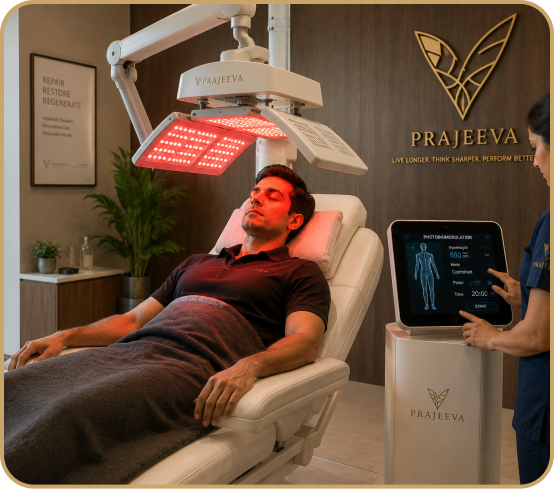
When recovery genuinely improves — measured in HRV trends, sleep quality scores, cognitive battery results, body composition and inflammatory marker trajectories — the lived experience changes in ways that are difficult to anticipate until they happen.
Sleep feels more restorative. Stress becomes easier to come back from. Mental clarity improves. Emotional balance feels steadier. Work feels less draining. Decisions come more easily. Stress passes through the system instead of accumulating in it. Physical effort becomes easier to tolerate. The body begins feeling capable again rather than compensating. This is not a vague aspiration. It is the measurable, predictable result of restoring the specific biological systems that were preventing recovery. Prajeeva’s recovery and regenerative therapies are built for individuals who want to understand why their body is not restoring itself the way it once did — and what can be done to support better resilience through physician-led, outcomes-measured care.
The goal is not a temporary feeling of restoration. It is a measurably restored biological baseline that holds.
Book Your Recovery Consultation Speak With Our Clinical Team
